
Microvascular Decompression Surgery in Delhi
Sudden, electric-shock pain in the face, or an eyelid that twitches without warning, can make eating, talking, and even smiling feel risky. Microvascular decompression (MVD) surgery in Delhi treats the cause of these problems by moving a blood vessel away from a compressed facial nerve.
Dr. Vikas Gupta, Senior Consultant Neurosurgeon at Kailash Deepak Hospital, Karkardooma, has over 30 years of neurosurgical experience. He reviews each patient’s MRI and treatment history individually to decide whether MVD, medicines, or another option suits them best.
Reach Out for Expert Care
What Is Microvascular Decompression (MVD) Surgery?
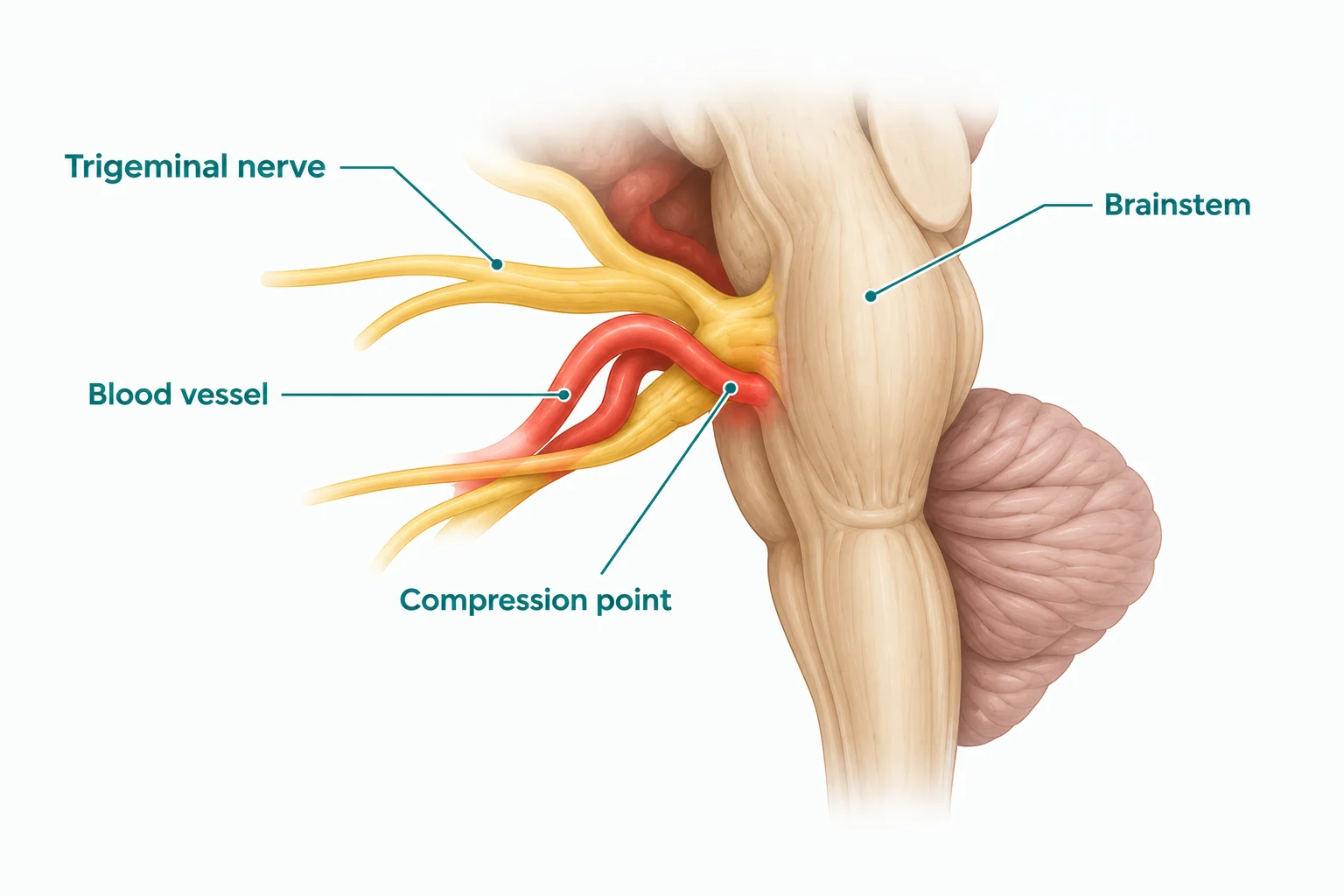
Microvascular decompression is a brain surgery that relieves pressure on a cranial nerve by moving the blood vessel pressing against it. It targets the cause of the pain rather than only masking it.
- A small opening is made in the skull behind the ear.
- A tiny cushion, usually Teflon felt, is placed between the nerve and the vessel.
- The nerve is not cut, so facial sensation is usually preserved.
Since it fixes the source, MVD is among the longest-lasting surgical options for suitable patients.
Which Conditions Does MVD Surgery Treat?
MVD treats three nerve conditions caused by blood-vessel compression: trigeminal neuralgia, hemifacial spasm, and glossopharyngeal neuralgia.
- Trigeminal neuralgia: stabbing facial pain set off by chewing, brushing teeth, or a light touch.
- Hemifacial spasm: involuntary twitching on one side of the face, often starting around the eye.
- Glossopharyngeal neuralgia: sharp pain in the throat, tongue, or ear, often triggered by swallowing.
An MRI confirms whether a vessel is touching the nerve before surgery is considered.
When Should You Consider MVD Surgery?
MVD is usually considered when medicines stop controlling symptoms or cause side effects that disrupt daily life.
- Tablets such as carbamazepine no longer work or cause drowsiness and dizziness.
- Botulinum toxin injections for hemifacial spasm wear off quickly.
- MRI shows clear contact between a vessel and the nerve.
- You are fit for general anaesthesia and want a long-term solution.
Surgery is not for everyone; Dr. Gupta also discusses medicines and radiosurgery options such as Gamma Knife or CyberKnife.
How Is MVD Surgery Performed?
MVD is done under general anaesthesia and usually takes two to four hours, with the surgeon working through a small opening behind the ear using an operating microscope.

- MRI review and anaesthesia check-up before surgery.
- A small skin incision and bone opening are made behind the ear.
- The microscope helps identify the vessel pressing on the nerve.
- The vessel is gently lifted away and a cushion is placed.
- The opening is closed, and you wake up in monitored care.
Nerve monitoring may be used when needed to help protect hearing and facial nerve function.
How Successful Is MVD Surgery for Trigeminal Neuralgia?
Large published studies report complete pain relief soon after MVD in roughly 82-91% of trigeminal neuralgia patients, with many staying largely pain-free ten years later.
- Long-term pain-free rates of about 65-85% at ten years are reported, depending on the study.
- Results are best in classic trigeminal neuralgia with clear vessel contact.
- Hemifacial spasm often settles within days to weeks.
- Pain can return in some patients, and repeat surgery or other options exist.
These are published literature ranges, not a guarantee for any individual.
What Are the Risks of MVD Surgery?
MVD is generally safe in experienced hands, but like any brain surgery it carries risks including hearing loss, facial numbness or weakness, cerebrospinal fluid (CSF) leak, and infection.
- Hearing loss is reported in roughly 1-7% of patients across studies.
- CSF leak is uncommon, around 1% in a large series.
- Temporary facial numbness, dizziness, or nausea may occur.
- Serious events such as stroke or bleeding are rare.
Your surgeon explains your personal risks before surgery; call the hospital promptly for fever, severe headache, or clear fluid leaking from the wound or nose.
What Is the MVD Surgery Recovery Time?
Most patients stay in hospital for about three to five days and return to light activity within a few weeks, as advised by the surgeon.
- Day 1-2: monitoring in the neuro ICU or high-dependency unit.
- Pain relief may be immediate or build over days to weeks.
- Headache, tiredness, and nausea are common early and usually settle.
- Medicines are reduced gradually and only under doctor supervision.
- Avoid heavy lifting and strenuous activity until you are cleared at follow-up.
Regular follow-up visits track your healing and symptom control.
How Much Does MVD Surgery Cost in Delhi?
The cost of microvascular decompression surgery in Delhi generally starts from ₹2,50,000 and might exceed way beyond depending on the condition treated and the complexity of the case.
Key factors that influence the cost:
- Condition treated (trigeminal neuralgia or hemifacial spasm) and surgical complexity
- First-time, revision, or both-sided surgery
- Use of intraoperative nerve monitoring
- Room category and length of hospital stay
- MRI and pre-operative investigations
- Follow-up care
Read the detailed MVD surgery cost in Delhi breakdown; an exact estimate is shared after your MRI review.
Dr. Vikas Gupta’s Education and Training in Neurosurgery
Dr. Vikas Gupta is a Senior Consultant Neurosurgeon at Kailash Deepak Hospital, Karkardooma, with formal training in general surgery, neurosurgery, and interventional neuroradiology.
- MBBS from Christian Medical College, Ludhiana (1987)
- MS in General Surgery from Punjab University, Chandigarh (1991)
- M.Ch in Neurosurgery from G.B. Pant Hospital and Maulana Azad Medical College, New Delhi (1998)
- Fellowship in Interventional Neuroradiology at University Hospital Zurich, Froedtert Hospital, and the University of Wisconsin, USA
This combined training in microsurgery and neurovascular care helps in assessing how a blood vessel is pressing on a nerve. You can read more about Dr. Gupta.
Consultation for MVD Surgery in Delhi: What to Prepare
If you or a family member has trigeminal neuralgia or hemifacial spasm, a neurosurgical consultation with MRI review is the usual first step to understand whether MVD is suitable.
Helpful things to bring:
- A recent MRI brain with films and report (ideally FIESTA/CISS sequences)
- A list of medicines tried, doses, and side effects
- A short diary of pain or spasm frequency and triggers
A consultation is for information and does not commit you to surgery. When you are ready, you can reach the clinic through the appointment page.
Frequently Asked Questions
Is MVD a major surgery? expand_more
Yes. It is a brain surgery done under general anaesthesia, but it is performed through a small opening behind the ear, and most patients go home within a few days.
Can trigeminal neuralgia come back after MVD? expand_more
In a minority of patients, yes. Recurrence rates vary between studies, and repeat surgery or radiosurgery may be options.
Will I stop taking medicines after MVD? expand_more
Many patients are able to reduce or stop pain medicines after successful surgery. Dr. Gupta tapers them gradually and only under supervision.
Who is the best neurosurgeon for trigeminal neuralgia in Delhi? expand_more
The right choice depends on your diagnosis and the surgeon's experience with MVD. Dr. Vikas Gupta has 30+ years of neurosurgical experience, and a consultation lets you review his approach and decide.

Dr. Vikas Gupta’s Medical Content Team
Dr. Vikas Gupta’s medical content team specialises in creating accurate, clear, and patient-focused healthcare content. With strong clinical understanding and expertise in technical writing and SEO, the team translates complex medical information into reliable, accessible resources that support informed decisions and uphold Dr. Gupta’s commitment to quality care.
This content is reviewed by Dr. Vikas Gupta
Related Blogs


What Is the Connection Between Headaches and Neurological Disorders?
Headaches are among the most common health complaints, affecting nearly 50% of the adult population…
Read Article → WhatsApp