
Tumour Embolisation Surgery in Delhi
When a brain or spinal tumour has a rich blood supply, surgery becomes significantly more complex and risky. Tumour embolisation surgery in Delhi is a minimally invasive procedure that targets the feeding blood vessels before or alongside definitive treatment, reducing blood loss, improving surgical safety, and, in certain cases, directly slowing tumour growth.
Dr. Vikas Gupta, Senior Consultant Neurosurgeon and Neurointerventional Specialist at Kailash Deepak Hospital, Karkardooma, Delhi, performs tumour embolisation as part of a multimodal treatment plan. With over 30 years of neurosurgical and neurointerventional experience, he evaluates each case carefully to determine whether embolisation will genuinely improve outcomes before recommending it.
Reach Out for Expert Care
What Is Tumour Embolisation?
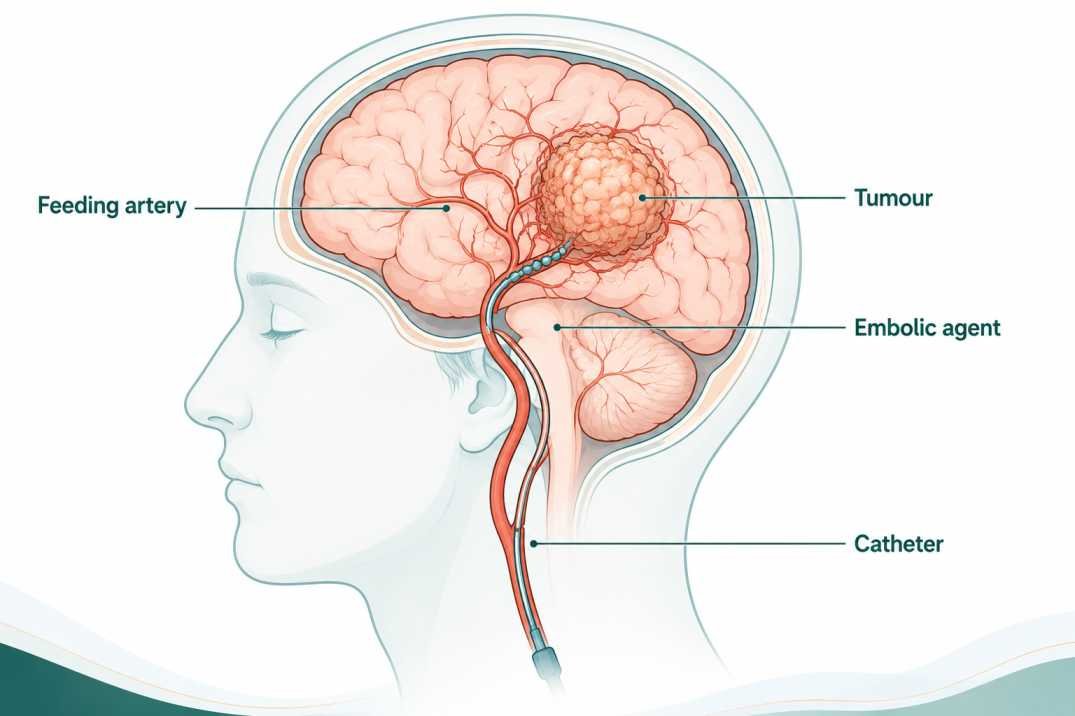
Tumour embolisation is a catheter-based procedure in which the blood vessels supplying a tumour are deliberately blocked. A thin, flexible tube (catheter) is guided through the bloodstream, usually via the femoral artery in the groin, to reach the vessels feeding the tumour. Once in position, tiny blocking agents called embolic materials are released to cut off the blood supply.
Without its blood supply, the tumour shrinks, becomes softer, and bleeds less during surgery. The procedure does not remove the tumour itself. It is performed to make surgery safer, or in some cases as a palliative measure to slow tumour growth and reduce symptoms when surgery is not the primary option.
Read more about Interventional Neuroradiology in Delhi →
Why Is Tumour Embolisation Performed?
Tumour embolisation is performed when a tumour has a high blood supply that would make direct surgery dangerous. It is most commonly used before surgical removal (pre-surgical embolisation) to reduce bleeding during the operation, or as a standalone treatment to relieve symptoms when surgery is not immediately possible.
The specific reasons a neurosurgeon may recommend embolisation include:
- Reducing intraoperative blood loss: Highly vascular tumours, particularly meningiomas, paragangliomas, and certain metastases, can cause serious haemorrhage during surgery. Embolisation performed 24-72 hours beforehand substantially reduces this risk.
- Shrinking tumour size: A reduced blood supply causes parts of the tumour to break down, making the surgeon’s job technically easier and potentially reducing the extent of surgery required.
- Improving surgical access: Softer, less vascular tumours are easier to remove completely, which matters for outcomes.
- Palliative control: For patients where curative surgery is not possible, embolisation can reduce tumour-related symptoms such as pain, swelling, and neurological pressure.
- Combination with radiosurgery: Some tumours are embolised before Gamma Knife or CyberKnife treatment to improve the accuracy and effectiveness of targeted radiation.
Which Tumours Are Treated with Embolisation?
Tumour embolisation is most commonly used for highly vascular brain and spinal tumours, including meningiomas, paragangliomas (glomus tumours), haemangioblastomas, and selected metastatic tumours with a rich blood supply. It is not appropriate for every tumour; the decision depends on the tumour’s location, vascularity, and the patient’s overall treatment plan.
Tumours that commonly benefit from embolisation:
- Meningioma
- Brain Tumours (General)
- Skull Base Tumours
- Paraganglioma / Glomus Tumours
- Haemangioblastoma
- Selected Metastatic Tumours
How Is Tumour Embolisation Surgery in Delhi Performed?
Tumour embolisation is performed under local anaesthesia with sedation, or under general anaesthesia in complex cases. The entire procedure is guided by real-time X-ray imaging (fluoroscopy) and takes between one and four hours depending on the tumour’s size and the number of feeding vessels involved.
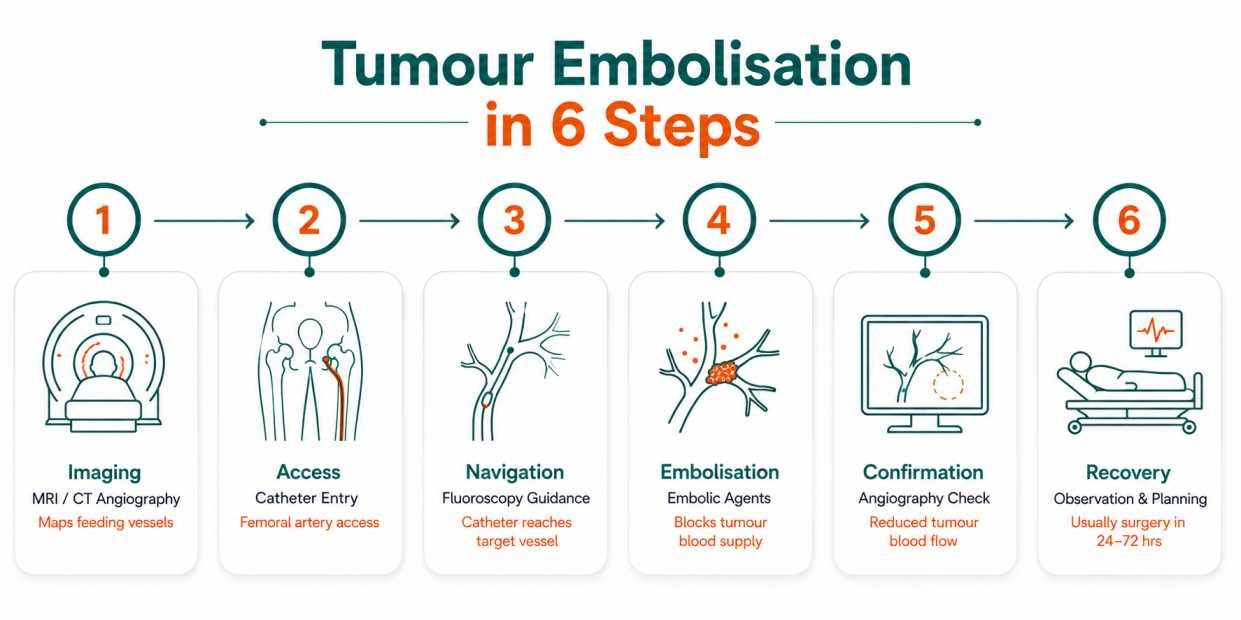
The procedure is performed in a dedicated interventional neuroradiology suite. After it is complete, patients are monitored in the ward or neuro-ICU, and definitive surgery, if planned, is typically scheduled within 24 to 72 hours to take advantage of the maximum devascularisation effect before collateral circulation develops.
Tumour Embolisation vs. Direct Surgery: How Do They Work Together?
Tumour embolisation is not a standalone cure; it is used alongside surgery, radiosurgery, or other treatment. Understanding how the two relate helps patients make sense of their treatment plan.
| Aspect | Tumour Embolisation | Direct Surgery / Radiosurgery |
| Purpose | Reduce blood supply, soften tumour | Remove or destroy the tumour |
| Incision | No incision (catheter via groin) | Craniotomy or keyhole approach |
| Anaesthesia | Local + sedation (usually) | General anaesthesia |
| Hospital Stay | 1-2 days | 3-7 days (for surgery) |
| Performed Alone? | Rarely, usually prepares for surgery | Yes, as primary treatment |
| Combined Benefit | Significantly reduces surgical blood loss | More complete removal possible |
What Are the Benefits of Pre-Surgical Tumour Embolisation?
Pre-surgical tumour embolisation reduces intraoperative blood loss, shortens operating time, and can allow more complete tumour removal. For highly vascular tumours, it can make the difference between a manageable operation and a high-risk one.
Key benefits include:
- Less blood loss during surgery, reducing the need for transfusion
- Shorter operating time due to a clearer, less vascular surgical field
- Improved chance of complete tumour removal
- Reduced surgical risk for elderly patients or those with other health conditions
- Better delineation of tumour boundaries during surgery
Tumour Embolisation Risk and Consideration
Like all endovascular procedures, tumour embolisation carries risks that need to be discussed honestly. It is generally safe in experienced hands, but the following are possible complications:
- Non-target embolisation: Embolic material inadvertently reaching normal brain vessels, causing a small stroke or neurological deficit. This risk is reduced significantly by careful pre-procedure angiography and using the appropriate embolic agent.
- Post-embolisation syndrome: Temporary fever, headache, and nausea in the days following the procedure, caused by tumour breakdown. It usually resolves with supportive care.
- Incomplete devascularisation: Some feeding vessels may not be safely accessible, limiting the effect of embolisation.
- Contrast allergy or kidney stress: Related to the contrast dye used during angiography.
- Recanalisation: Blocked vessels can, in rare cases, reopen over time — which is why surgery is planned promptly after embolisation.
Dr. Vikas Gupta discusses each patient’s individual risk profile in detail before recommending the procedure. Embolisation is only advised when the expected benefit to the surgical outcome justifies the procedural risk.
Recovery After Tumour Embolisation
Recovery from tumour embolisation itself is generally straightforward, with most patients discharged within 24 to 48 hours. Since embolisation is typically a preparatory step before surgery, the full recovery timeline depends on the subsequent surgical or radiosurgical treatment.
What to expect after embolisation:
- Day 1: Bed rest with monitoring of the catheter entry site (groin). Neurological observations every few hours.
- Day 1-2: Possible mild headache or fatigue from post-embolisation syndrome. Managed with medication.
- Days 2-3: Most patients are mobile and discharged. Surgery is usually scheduled within this window.
- After surgery: Recovery follows the timeline for the specific surgical procedure performed.
Patients who receive embolisation as a standalone palliative treatment, rather than as a pre-surgical step, will have a follow-up imaging review within 4–6 weeks to assess tumour response.
Tumour Embolisation Surgery Cost in Delhi
The cost of tumour embolisation in Delhi generally ranges from ₹1,50,000 to ₹3,50,000 for the embolisation procedure itself, depending on the complexity of the case, the type of embolic agents used, imaging requirements, and duration of hospital stay. When performed as part of a broader surgical admission, costs are typically included within the overall treatment estimate.
Factors that influence the total cost:
- Number of feeding vessels requiring embolisation
- Type of embolic agent used (particles, coils, liquid embolics)
- Pre-procedure imaging (MRI, CT angiography, DSA)
- Duration of hospital stay and ICU monitoring
- Whether standalone or combined with tumour surgery
A transparent, itemised cost breakdown is provided after the initial consultation. Insurance coverage queries can be addressed at the time of booking.
Why Patients Choose Dr. Vikas Gupta for Tumour Embolisation in Delhi?
Patients from across East Delhi, Delhi NCR, and neighbouring states seek Dr. Vikas Gupta for tumour embolisation because neurointerventional procedures require both imaging expertise and a deep understanding of the surgical step that follows. He performs both.
- 30+ Years of Neurosurgical and Neurointerventional Experience
- Dual Expertise: Performs both the embolisation and, where required, the subsequent brain tumour surgery, so the plan is coordinated from day one
- Advanced Imaging and Catheter Suite at Kailash Deepak Hospital, with digital subtraction angiography (DSA) capability
- Individualised Assessment: Embolisation is only recommended when it genuinely improves the surgical outcome, not as a routine add-on
- Trusted by Patients from Karkardooma, Anand Vihar, East Delhi, and across Delhi NCR
Book a Consultation for Tumour Embolisation in Delhi
If you or a family member has been diagnosed with a highly vascular brain or spinal tumour and surgery is being planned, an embolisation assessment may be an important step in ensuring the safest possible outcome.
During your consultation with Dr. Vikas Gupta:
- Review of MRI, CT, and angiography reports
- Assessment of whether embolisation is appropriate for your tumour type and location
- Clear explanation of how embolisation fits into your overall treatment plan
- Honest discussion of risks, expected benefits, and alternatives
- Transparent cost and timeline guidance
For urgent neurological symptoms, sudden severe headache, new weakness, vision loss, or confusion, seek emergency care immediately.
Frequently Asked Questions
Is tumour embolisation painful? expand_more
The procedure is performed under local anaesthesia with sedation, so patients do not feel pain during the procedure. Mild headache and fatigue are common in the day or two after, related to the tumour's reaction to reduced blood flow.
How long does tumour embolisation take? expand_more
The procedure typically takes between one and four hours, depending on the number and accessibility of the feeding vessels.
Can tumour embolisation be done for spinal tumours as well? expand_more
Yes. Pre-surgical embolisation is performed for highly vascular spinal tumours, particularly metastases and haemangioblastomas, to reduce blood loss during spinal surgery.
How can I book an appointment with Dr. Vikas Gupta? expand_more
You can book an appointment with Dr. Vikas Gupta by contacting Neurological Hall or Kailash Deepak Hospital, Karkardooma, directly, or using their online appointment booking facilities.
How can I book an appointment at Kailash Deepak Hospital? expand_more
You can book an appointment at Kailash Deepak Hospital by calling the hospital reception directly or using the online appointment booking facility on the hospital's website.

Dr. Vikas Gupta’s Medical Content Team
Dr. Vikas Gupta’s medical content team specialises in creating accurate, clear, and patient-focused healthcare content. With strong clinical understanding and expertise in technical writing and SEO, the team translates complex medical information into reliable, accessible resources that support informed decisions and uphold Dr. Gupta’s commitment to quality care.
This content is reviewed by Dr. Vikas Gupta
 WhatsApp