
Blood clots that block a major artery in the brain cut off oxygen supply within minutes, and every minute of delay costs brain tissue. Thrombectomy for stroke in Delhi is a minimally invasive, catheter-based procedure that physically removes this clot and restores blood flow, often reversing stroke symptoms when performed within the critical treatment window.
Dr. Vikas Gupta, Senior Consultant Neurosurgeon and Neurointerventional Specialist at Kailash Deepak Hospital, Karkardooma, with over 30 years of experience in cerebrovascular and neurointerventional care, performs mechanical thrombectomy for eligible ischaemic stroke patients across Delhi NCR. Every case is evaluated on imaging, clot location, and time from symptom onset before a treatment decision is made.
Reach Out for Expert Care
What Is Mechanical Thrombectomy for Stroke?
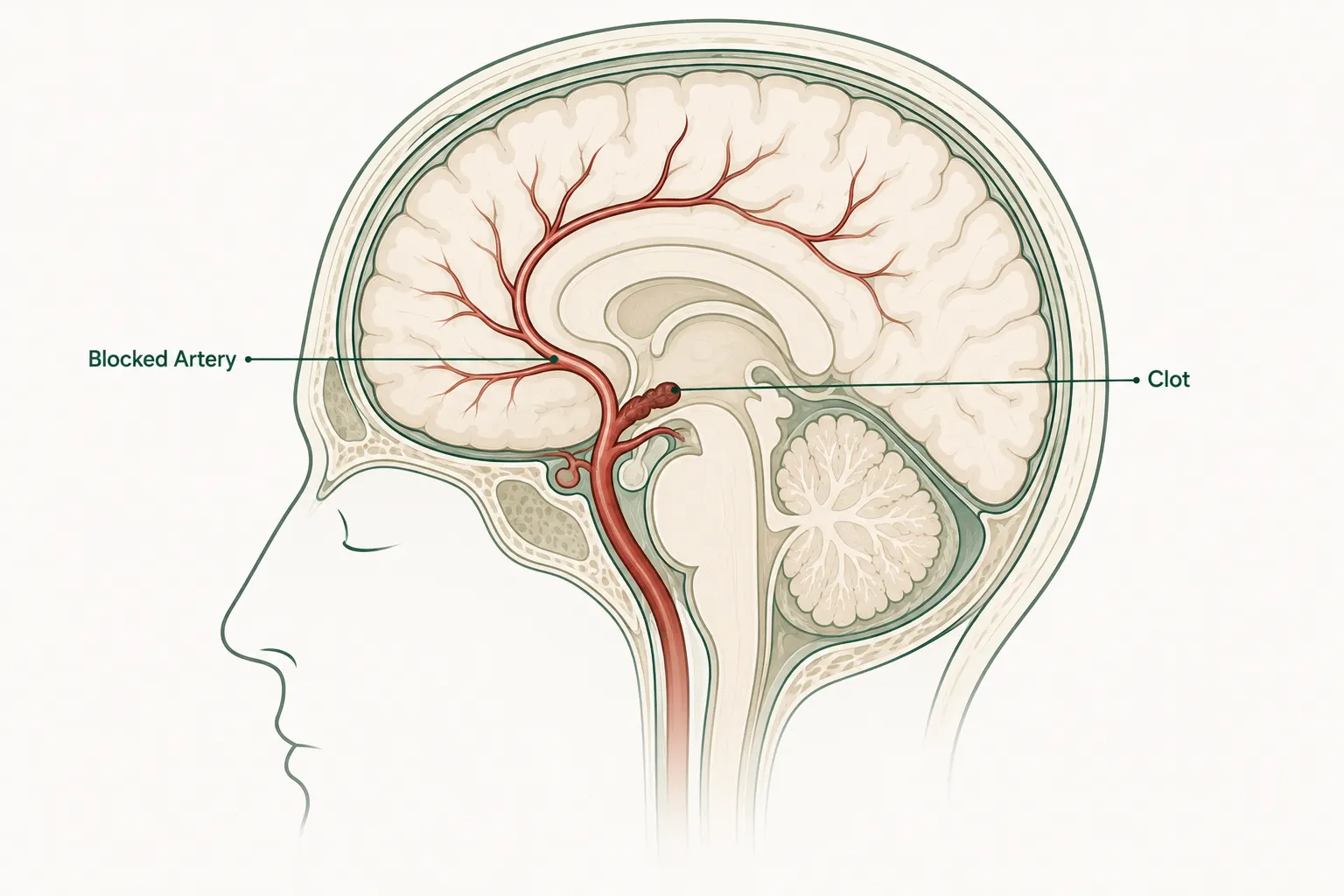
Mechanical thrombectomy is a minimally invasive procedure that removes a blood clot from a blocked brain artery using a catheter, without open surgery.
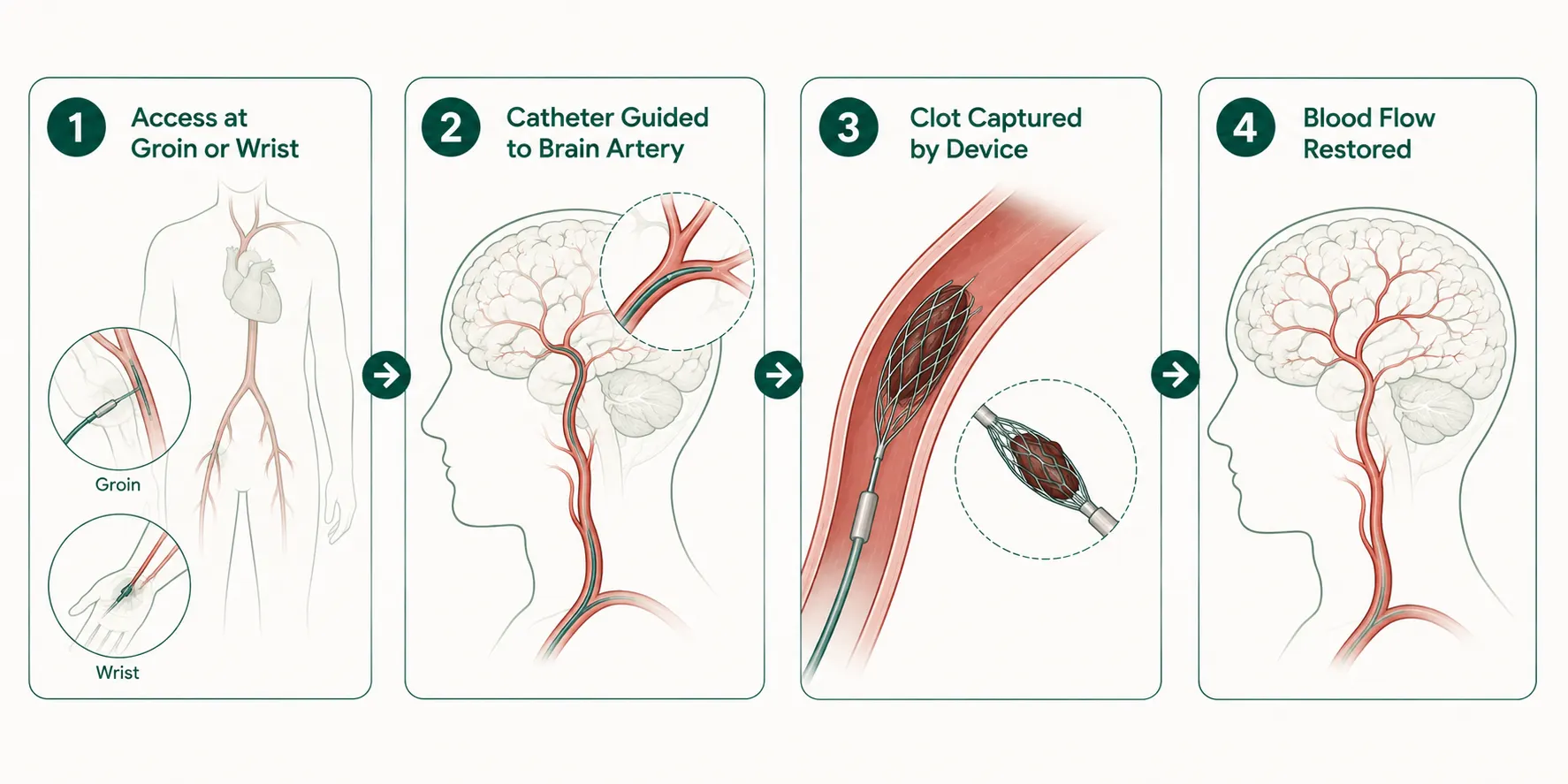
- A thin catheter is guided through the blood vessels, usually from the groin or wrist, up to the blocked artery in the brain
- A specialised device, called a stent retriever or aspiration catheter, captures and withdraws the clot
- Blood flow to the affected part of the brain is restored, limiting further tissue damage
- The procedure is performed under X-ray (fluoroscopic) guidance for precision
This approach is used specifically for ischaemic strokes caused by a large vessel occlusion (LVO) and is distinct from clot-dissolving medication, which works differently and suits a different patient profile.
Who Needs a Thrombectomy for Stroke?
Thrombectomy is recommended for patients with an ischaemic stroke caused by a blockage in a major brain artery, confirmed on imaging, within a defined treatment window.
Eligibility is generally based on:
- A confirmed large vessel occlusion on CT or MR angiography
- Time since symptom onset, typically up to 6 hours, and up to 24 hours in select patients based on advanced imaging
- Amount of brain tissue that is still salvageable (assessed via perfusion imaging)
- Overall health status and absence of large, completed infarct or major bleeding risk
- Severity of neurological deficit at presentation
Not every stroke patient is a candidate. A neurointerventional specialist confirms suitability urgently, since eligibility is time-sensitive.
Thrombectomy in Delhi for Stroke: Procedure
Thrombectomy is performed under image guidance through a small puncture in the groin or wrist, with the entire procedure typically completed within 30-90 minutes.
- Rapid imaging: CT/CT angiography confirms the blocked artery and salvageable brain tissue
- Vascular access: A catheter is inserted through the femoral (groin) or radial (wrist) artery
- Navigation to the clot: The catheter is guided through the blood vessels to the blocked brain artery using live X-ray imaging
- Clot retrieval: A stent retriever or aspiration device captures and removes the clot
- Flow restoration check: Angiography confirms blood flow has been restored
- Recovery monitoring: The patient is shifted to a neuro-ICU for close observation
Since speed directly affects outcomes, the process from hospital arrival to clot removal is kept as short as possible.
What Are the Benefits of Thrombectomy Over Clot-Dissolving Medication?
Thrombectomy physically removes the clot and works for larger blockages that clot-dissolving medication alone often cannot fully clear.
- Effective for large vessel occlusions, where medication response is limited
- Can be used alongside clot-dissolving drugs (bridging therapy) or on its own when medication is not suitable
- Offers a longer treatment window in carefully selected patients based on imaging
- Multiple clinical trials have shown improved rates of functional independence at 90 days when thrombectomy is added to standard stroke care, compared to medical management alone
The right approach, medication, thrombectomy, or both, depends on clot location, timing, and individual patient factors, and is decided after emergency imaging.
Recovery After Stroke Thrombectomy
Most patients are monitored in a neuro-ICU for 24-48 hours after thrombectomy, with recovery beyond that depending on how much brain tissue was affected before the clot was removed.
- First 24-48 hours: Close neurological monitoring, blood pressure control, and imaging to confirm no bleeding
- First week: Assessment for rehabilitation needs; hospital stay is typically 3-7 days depending on stroke severity
- Weeks to months: Physiotherapy, speech therapy, or occupational therapy as needed, based on deficits present
- Ongoing: Management of underlying risk factors such as blood pressure, diabetes, and cholesterol to prevent recurrence
Recovery outcomes vary widely and depend heavily on how early treatment was started after symptom onset.
Thrombectomy Cost in Delhi
The cost of thrombectomy for stroke in Delhi starts from ₹4,00,000 and may vary depending on the complexity of the case and length of hospital stay. Key factors that influence the cost:
- Type of device used (stent retriever vs aspiration system)
- Duration of ICU and hospital stay
- Additional imaging (CT, MR, or catheter angiography)
- Whether combined with clot-dissolving medication
- Post-procedure rehabilitation needs
A personalised consultation is essential to determine an accurate cost estimate based on individual clinical findings. See detailed stroke treatment cost breakdown →
Why Does the Treatment Window Matter So Much in Stroke?
In stroke care, brain tissue is lost every minute a blockage remains untreated, which is why thrombectomy outcomes are strongly time-dependent.
- Approximately 1.9 million neurons can be lost per minute during an untreated large vessel stroke
- Earlier clot removal is consistently linked to better functional recovery
- Recognising stroke symptoms, sudden weakness, facial drooping, slurred speech, immediately and reaching a stroke-ready hospital fast is the single biggest factor a family can control
- Emergency evaluation, not waiting to “see if it improves,” gives the best chance of a full recovery
Acting within the first few hours of symptom onset can be the difference between recovery and permanent disability.
Why Do Patients Consult Dr. Vikas Gupta for Thrombectomy in Delhi?
Patients across East Delhi and Delhi NCR consult Dr. Vikas Gupta for stroke thrombectomy because of:
- 30+ years of experience in neurosurgery and neurointerventional procedures
- Dedicated expertise in endovascular and catheter-based cerebrovascular treatment
- Access to emergency imaging and a dedicated neuro-ICU at Kailash Deepak Hospital
- Individualised eligibility assessment based on imaging, not a one-size-fits-all protocol
- Clear, transparent communication with families during a time-critical emergency
Book a Consultation for Thrombectomy in Delhi
Stroke is a medical emergency. If you or a family member notices sudden weakness, facial drooping, slurred speech, or vision changes, seek emergency care immediately rather than waiting for a scheduled consultation.
For planned evaluation, second opinions, or post-stroke follow-up, connect with Dr. Vikas Gupta’s team to discuss imaging findings, treatment suitability, and next steps.

 WhatsApp