
Meningioma Treatment in Delhi
Meningiomas are the most common primary brain tumours in adults, accounting for approximately 30-35% of all brain tumours. The vast majority (approximately 85-90%) are benign (non-cancerous), though they can still cause significant symptoms due to their location and pressure on brain structures.
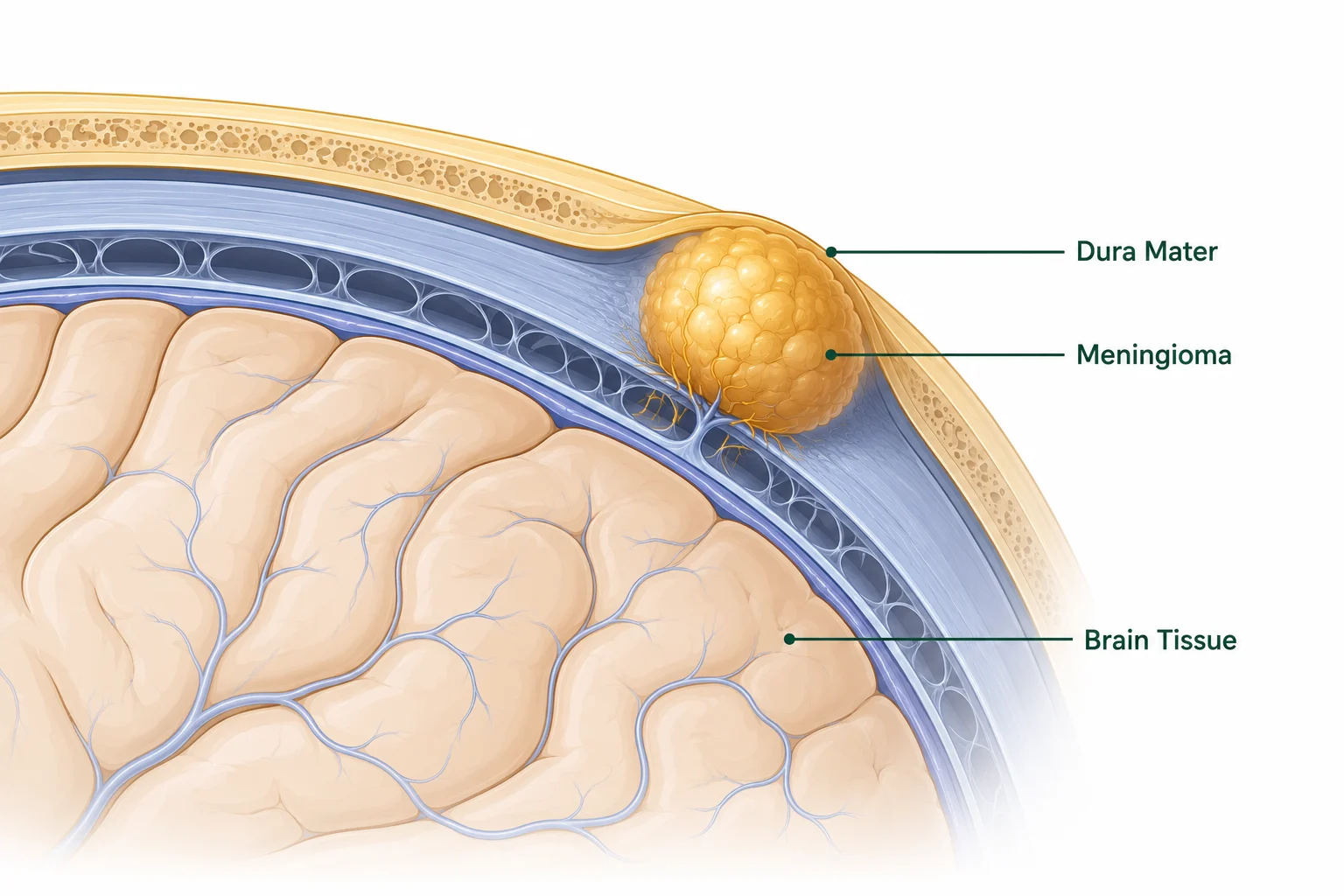
Dr. Vikas Gupta, a senior consultant neurosurgeon and neurointerventionalist at Kailash Deepak Hospital, provides comprehensive meningioma treatment in Delhi using advanced microsurgical techniques, neuro-navigation systems, and a multidisciplinary approach for the best possible outcomes.
Reach Out for Expert Care
What Is a Meningioma?
A meningioma is a tumour that grows from the meninges, the protective membrane layers covering the brain and spinal cord, and it is the most common type of primary brain tumour in adults.
Meningiomas typically grow slowly over many years and may not cause symptoms initially. As they enlarge, they can compress adjacent brain tissue, nerves, or blood vessels, leading to various neurological symptoms. Early diagnosis and appropriate treatment are essential for optimal outcomes.
Understanding the tumour’s type and growth pattern is the first step in planning safe, effective treatment.
Meningioma Types
Meningiomas are classified by their location in the skull or spine and by a WHO grading system that reflects how the tumour is likely to behave.
By Location:
- Convexity meningiomas: On the brain’s outer surface, generally the most accessible
- Parasagittal/falcine meningiomas: Near the midline and major venous drainage
- Skull base meningiomas: Sphenoid wing, olfactory groove, tuberculum sellae, petroclival, foramen magnum
- Spinal meningiomas: Arising from spinal cord coverings, more common in women
By WHO Grade:
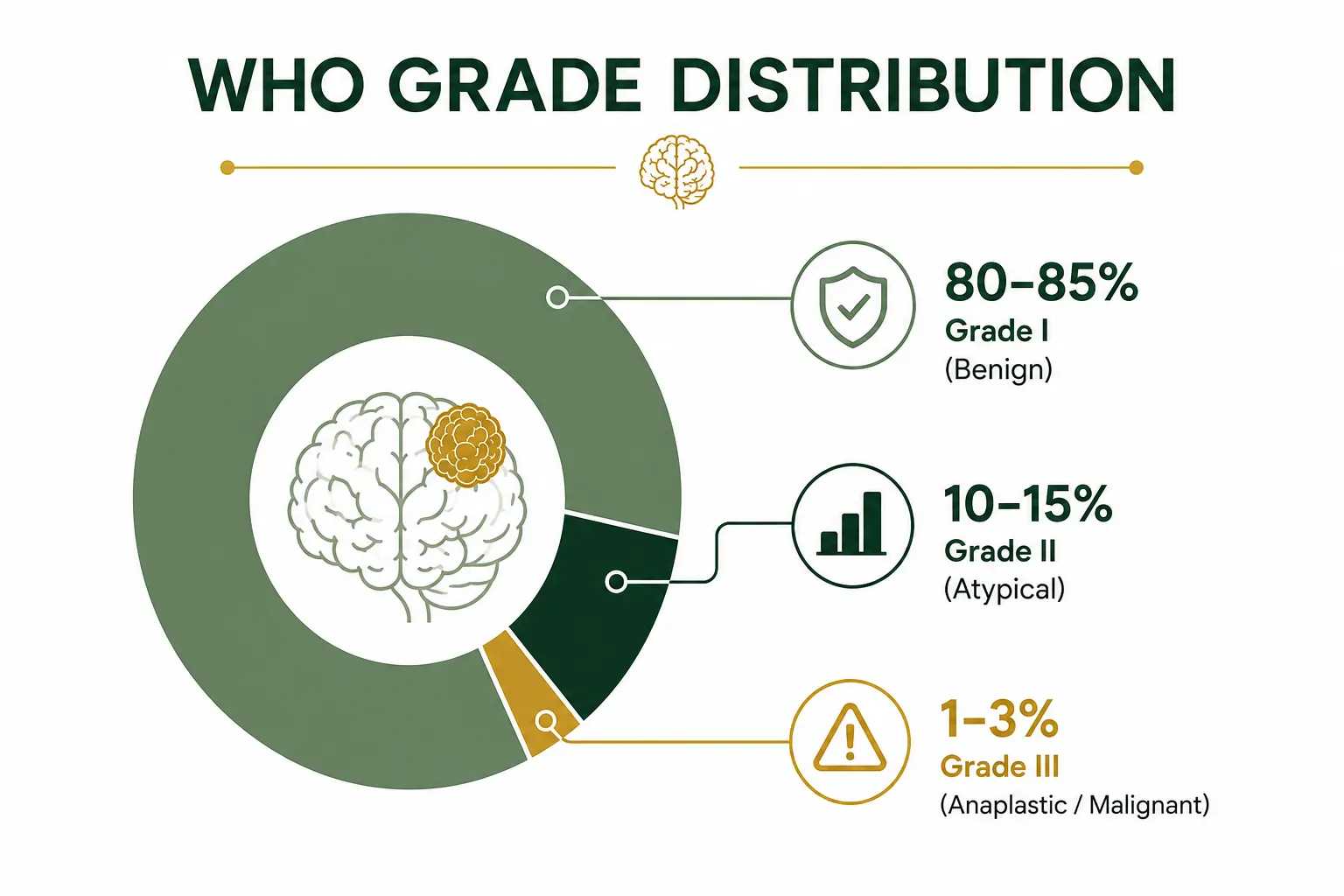
The exact grade is confirmed only after histopathological examination of the removed tissue.
Meningioma Symptoms and Signs
Persistent headaches, new seizures, and gradual vision or memory changes are the most common warning signs of a meningioma and warrant a neurosurgical evaluation.
- Persistent or worsening headaches
- New-onset seizures
- Blurred or double vision, or visual field loss
- Hearing loss or tinnitus
- Weakness or numbness in the arms or legs
- Speech difficulty, memory lapses, or personality changes
- Loss of sense of smell
Since meningiomas grow slowly, symptoms often develop gradually; persistent or worsening symptoms should never be ignored.
Meningioma Diagnosis in Delhi
An MRI brain with contrast is the primary diagnostic test for meningioma, supported by CT imaging and, in select cases, vascular or functional studies.
- MRI with contrast: Confirms tumour size, location, and characteristics
- CT scan: Identifies calcification and bone involvement
- CT/MR angiography: Maps blood supply near the tumour
- Functional MRI: Locates critical speech and movement centres
- Visual field or hearing tests: For tumours near the optic or acoustic pathways
These investigations allow Dr. Gupta to build a treatment plan tailored to each patient’s tumour and overall health.
Meningioma Treatment Options in Delhi
Meningioma treatment ranges from active monitoring for small, symptom-free tumours to surgical removal, radiosurgery, or radiotherapy for larger or symptomatic ones.
- Observation: For small, incidental tumours or elderly/high-risk patients, with regular MRI follow-up
- Craniotomy and surgical resection: The primary treatment for symptomatic meningiomas, using microsurgical technique and neuro-navigation (Craniotomy Surgery in Delhi)
- Endoscopic approaches: Minimally invasive removal for selected skull-base tumours (Endoscopic Brain Surgery in Delhi, Minimally Invasive Brain Tumour Removal)
- Awake craniotomy: Used near speech or movement centres to preserve function during removal
- Stereotactic radiosurgery: Gamma Knife or CyberKnife for small, deep, or residual tumours (Gamma Knife Surgery in Delhi, CyberKnife Treatment in Delhi)
- Fractionated radiotherapy: For atypical/malignant tumours or after incomplete resection
The right approach depends on the tumour’s size, grade, and location, decided after multidisciplinary review.
Meningioma Surgery Procedure in Delhi NCR
Meningioma surgery involves a craniotomy under general anaesthesia, during which the tumour is carefully separated from surrounding brain tissue and removed using image-guided microsurgical technique.
- Before surgery: Pre-operative assessment, anaesthetic clearance, and imaging-based planning
- During surgery: Craniotomy, navigation-guided tumour localisation, careful microsurgical removal, and dural closure (typically 3-8 hours)
- After surgery: ICU/HDU monitoring, post-operative imaging, and gradual mobilisation; hospital stay is usually 5-10 days, with histopathology results in 7-10 days
Careful surgical planning and intraoperative monitoring help protect critical brain function during the procedure.
What Is Recovery Like After Meningioma Treatment?
Most patients begin light activity within 2-4 weeks of meningioma surgery, with driving and work resuming gradually over 6-12 weeks depending on recovery.
- Hospital stay: 5-10 days, with wound checks and a post-operative MRI before discharge
- At home: Gradual increase in activity, avoiding heavy lifting or straining initially
- Rehabilitation (if needed): Physiotherapy, speech therapy, or occupational therapy for any neurological deficit
- Return to normal life: Light activity in 2-4 weeks; driving and work typically after 6-12 weeks, with medical clearance
Recovery timelines are personalised, and Dr. Gupta’s team monitors progress at every follow-up visit.
Meningioma Treatment Cost in Delhi
The cost of meningioma treatment in Delhi typically starts from ₹2,00,000 and goes way beyond depending on the type and complexity of treatment required.
- Type and complexity of surgery (craniotomy, endoscopic, or awake craniotomy)
- ICU/HDU care and length of hospital stay
- Diagnostic imaging and pre-operative investigations
- Need for additional radiosurgery or radiotherapy
- Post-operative rehabilitation
A precise estimate is only possible after clinical evaluation and imaging review. For a general reference on related procedure costs, see Brain Tumour Surgery Cost in Delhi.
Why Do Patients Consult Dr. Vikas Gupta for Meningioma Care in Delhi?
Patients across Delhi NCR consult Dr. Vikas Gupta for meningioma evaluation based on his 30+ years of neurosurgical experience and personalised, evidence-based treatment planning.
- 30+ years of neurosurgical experience with 5,000+ procedures performed
- Expertise across microsurgical and minimally invasive endoscopic techniques
- Individualised treatment planning based on tumour grade, location, and patient health
- Clear, transparent communication on diagnosis, risks, and recovery
- Regular consultations with patients from Karkardooma, Anand Vihar, East Delhi, Noida, and Ghaziabad
Related reading: Brain Tumour Treatment | Skull Base Tumour Care | Skull Base Surgery
Book a Consultation for Meningioma Treatment in Delhi
A consultation for meningioma includes a full review of imaging, a neurological examination, and a clear explanation of treatment options and costs.
During your visit, you can expect:
- Review of symptoms and medical history
- Neurological examination
- MRI/CT report assessment
- Explanation of tumour grade and treatment approach
- Discussion of risks, recovery, and cost
Early evaluation supports timely, informed treatment decisions.
Frequently Asked Questions
Is a meningioma cancerous? expand_more
Most meningiomas (about 85-90%) are benign, WHO Grade I tumours. A smaller percentage are atypical (Grade II) or malignant (Grade III) and need more aggressive treatment.
Does every meningioma need surgery? expand_more
No. Small, symptom-free meningiomas found incidentally may only need regular MRI monitoring. Surgery is generally recommended when the tumour is symptomatic, growing, or in a high-risk location.
Can a meningioma come back after surgery? expand_more
Recurrence is possible, more so with Grade II or III tumours or incomplete removal. Regular follow-up MRI scans are used to monitor for recurrence.
How can I book an appointment with Dr. Vikas Gupta? expand_more
You can book an appointment with Dr. Vikas Gupta by contacting us directly, using our online appointment booking facilities, available on this website.
How can I book an appointment at Kailash Deepak Hospital? expand_more
You can book an appointment at Kailash Deepak Hospital by calling the hospital reception directly or using the online appointment booking facility on the hospital's website.

Dr. Vikas Gupta’s Medical Content Team
Dr. Vikas Gupta’s medical content team specialises in creating accurate, clear, and patient-focused healthcare content. With strong clinical understanding and expertise in technical writing and SEO, the team translates complex medical information into reliable, accessible resources that support informed decisions and uphold Dr. Gupta’s commitment to quality care.
This content is reviewed by Dr. Vikas Gupta
Related Blogs
From Diagnosis to Treatment: What Role Does Neuro-Oncology Play in Enhancing Patient Outcomes?
According to the World Health Organization (WHO), primary brain tumors account for approximately 2% of…
Read Article →

 WhatsApp