
Endoscopic Brain Surgery in Delhi
When a brain condition is diagnosed, the words “surgery” can feel overwhelming. Endoscopic brain surgery in Delhi is now a well-established, safe, and highly effective treatment approach.
Dr. Vikas Gupta, a senior consultant neurosurgeon at Kailash Deepak Hospital, Karkardooma, is among the most experienced specialists performing this procedure in the Delhi NCR region. He uses advanced endoscopic techniques to treat complex brain conditions with the precision that patients and families deserve. Whether you are dealing with a brain tumour, hydrocephalus, a pituitary growth, or a deep-seated cyst, endoscopic brain surgery may offer you a safer and faster path to recovery.
Reach Out for Expert Care
What Is Endoscopic Brain Surgery?
Endoscopic brain surgery is a minimally invasive neurosurgical procedure in which a thin, flexible tube fitted with a high-definition camera and micro-instruments, called an endoscope, is used to access, visualise, and treat conditions inside the brain without the need for large incisions or full skull openings.
Unlike traditional open brain surgery (craniotomy), the endoscope is guided through a small keyhole incision or, in some cases, through the nose or a natural body opening. This allows the surgeon to directly visualise and operate on the affected area while causing minimal disruption to surrounding healthy brain tissue.
The result? Smaller surgical wounds, less blood loss, reduced pain, shorter hospital stay, and a faster return to normal life, all while maintaining the same surgical accuracy expected in complex neurosurgical care.
Learn more about Craniotomy Surgery →
Conditions Treated with Endoscopic Brain Surgery
Endoscopic brain surgery can be used to diagnose and treat a wide range of neurological conditions, including brain tumours, hydrocephalus, pituitary tumours, arachnoid cysts, skull base lesions, and intraventricular bleeding.
Dr. Vikas Gupta performs endoscopic neurosurgery for the following conditions:
- Brain Tumours: Especially tumours located in the ventricles or skull base that are difficult to reach through traditional surgery. Read about Brain Tumour Treatment →
- Hydrocephalus (Fluid in the Brain): Endoscopic Third Ventriculostomy (ETV) is a keyhole procedure that creates a new drainage channel to relieve pressure caused by excess cerebrospinal fluid. Read about Hydrocephalus →
- Pituitary Tumours: Performed entirely through the nose (transsphenoidal route), allowing removal without any external scar. Read about Endoscopic Pituitary Surgery →
- Arachnoid Cysts: Fluid-filled sacs between the brain and its protective membranes can be drained endoscopically.
- Intraventricular Haemorrhage: Blood that has collected inside the brain’s fluid-filled chambers can be cleared using endoscopic techniques.
- Skull Base Tumours & Lesions: Lesions at the base of the brain are accessible via endoscopic skull base surgery with minimal tissue disruption.
- Colloid Cysts: Benign cysts in the third ventricle that cause headaches and memory problems can be safely removed endoscopically.
View All Conditions Treated by Dr. Vikas Gupta →
Types of Endoscopic Brain Surgery
Endoscopic brain surgery types include endoscopic third ventriculostomy (ETV), endoscopic pituitary surgery, endoscopic tumour resection, and endoscopic skull base surgery. The type recommended depends on the patient’s condition and the exact location of the problem.
1. Endoscopic Third Ventriculostomy (ETV)
Used to treat obstructive hydrocephalus, this procedure creates a small bypass channel in the floor of the brain’s third ventricle, allowing cerebrospinal fluid (CSF) to drain naturally, often eliminating the need for a shunt.
2. Endoscopic Pituitary Surgery (Transsphenoidal)
Performed entirely through the nasal passage, this approach is ideal for pituitary tumours and skull base lesions. There are no external incisions, no visible scars, and recovery is significantly faster.
3. Endoscopic Intraventricular Tumour Removal
Tumours within the brain’s ventricles, such as colloid cysts or ependymomas, can be accessed and removed using a rigid or flexible endoscope passed through a small burr hole in the skull.
4. Endoscopic Skull Base Surgery
Used for tumours and lesions at the base of the brain, this approach avoids the need to lift or retract the brain, making it safer and allowing quicker post-operative recovery.
5. Neuroendoscopic-Assisted Procedures
In some complex cases, the endoscope is used alongside microsurgical tools to provide a broader field of vision and improve precision. This is especially useful in deep-seated or unusual-shaped lesions.
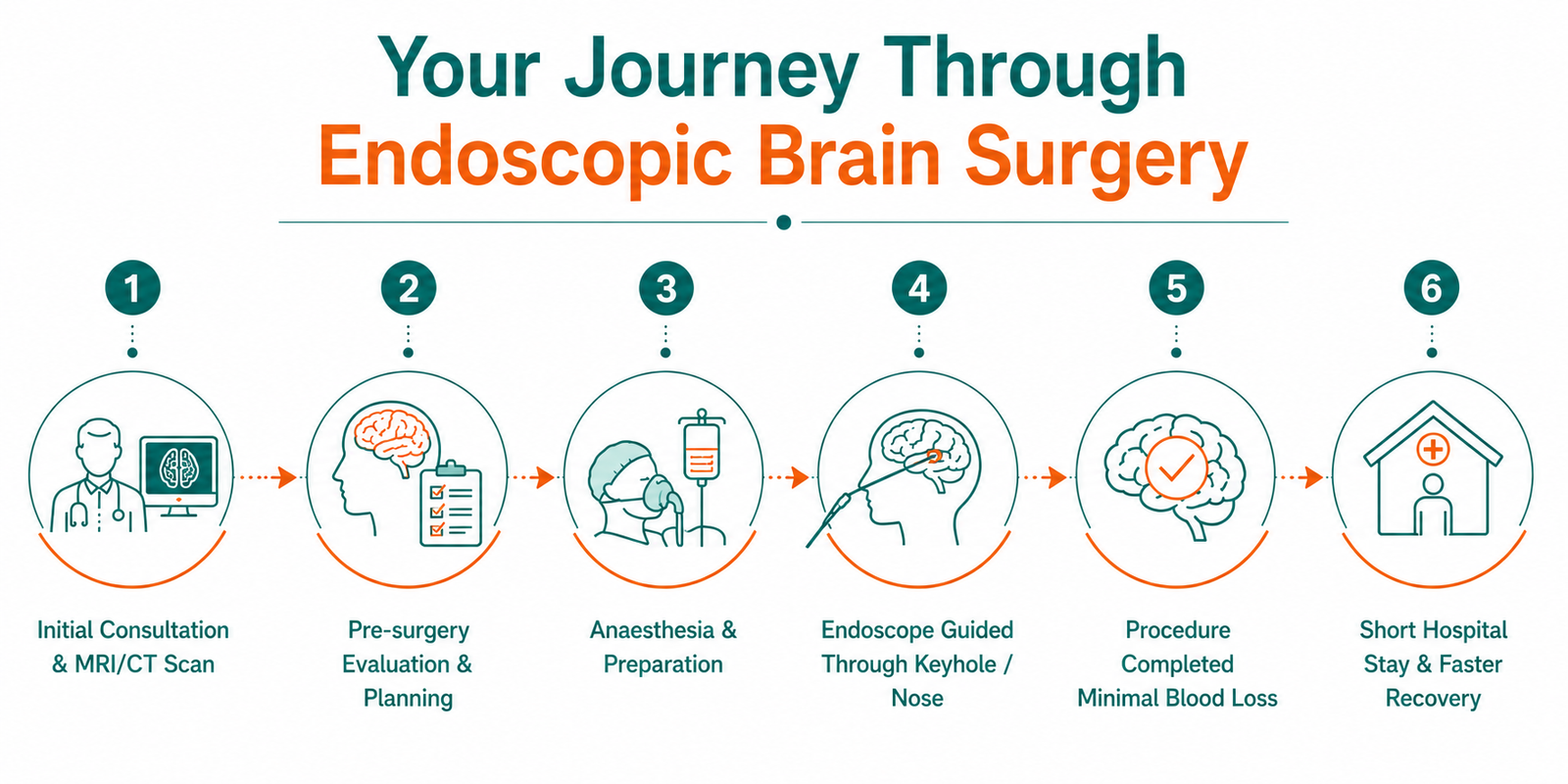
Endoscopic Brain Surgery Procedure: A Step-by-Step Guide
Endoscopic brain surgery is performed under general anaesthesia. A small incision or natural passage (such as the nose) is used to insert the endoscope, which transmits real-time, high-definition images to guide the surgeon in removing or treating the target area with minimal disruption to healthy tissue.
Here is what the procedure typically involves:
Step 1: Pre-surgical Evaluation
Dr. Gupta reviews your MRI or CT scans carefully, along with your overall health status, to plan the most suitable endoscopic approach for your specific condition.
Step 2: Anaesthesia
You will be placed under general anaesthesia, so you are completely asleep and pain-free during the surgery.
Step 3: Small Incision or Natural Access
A tiny incision (usually less than 2 cm) is made in the scalp, or, in the case of pituitary and skull base surgeries, the endoscope is inserted through the nose. There is no need to remove a large section of the skull.
Step 4: Endoscope Insertion
The endoscope, equipped with a camera and light source, is gently guided to the treatment area. The surgeon sees real-time, magnified, high-resolution images on a monitor throughout the procedure.
Step 5: Treatment
Using micro-instruments passed through the endoscope’s working channel, the surgeon removes the tumour, drains the cyst, clears the clot, or creates a bypass pathway, depending on the condition being treated.
Step 6: Closure & Recovery
Once the procedure is complete, the small incision is closed. Most patients begin walking within 24 hours and are discharged within 2 to 4 days, depending on the complexity of surgery.
Benefits of Endoscopic Brain Surgery Over Traditional Open Surgery
Endoscopic brain surgery offers significant advantages over traditional open surgery: smaller incisions, less blood loss, lower risk of infection, minimal disruption to healthy brain tissue, shorter hospital stay (typically 2-4 days), and faster overall recovery, often allowing patients to return home within a week.
Here is a clear comparison:
| Feature | Endoscopic Brain Surgery | Traditional Open Brain Surgery |
| Incision Size | Very small (keyhole) | Large craniotomy opening |
| Hospital Stay | 2-4 days (typical) | 5-10 days or more |
| Blood Loss | Minimal | More significant |
| Recovery Time | Faster (2-4 weeks) | Longer (6-8 weeks) |
| Visible Scarring | Minimal to none | More noticeable |
| Brain Tissue Disruption | Minimal | Greater |
| Risk of Infection | Lower | Higher |
| Return to Daily Activities | Sooner | Later |
Note: Suitability depends on the type, size, and location of the condition. Dr. Vikas Gupta will recommend the most appropriate approach after careful evaluation.
Who Is a Good Candidate for Endoscopic Brain Surgery?
You may be a good candidate for endoscopic brain surgery if you have a brain tumour in or near the ventricles, hydrocephalus, a pituitary tumour, an arachnoid cyst, or intraventricular bleeding. A neurosurgeon will assess your imaging, medical history, and overall health to determine if this approach is safe and appropriate for you.
Patients who typically benefit from this approach include:
- Those with small to moderate-sized brain tumours in accessible locations
- Patients with hydrocephalus who are suitable for ETV rather than a VP shunt
- Individuals with pituitary tumours causing hormone imbalances or vision problems
- Patients who are at higher risk with open surgery due to age or other health conditions
- Those who want to minimise surgical trauma and recovery time.
Risks and Complications of Endoscopic Brain Surgery: What to Know?
Like all surgeries, endoscopic brain surgery carries some risks, including bleeding, infection, damage to nearby brain structures, and in rare cases, incomplete removal of the target tissue. However, in the hands of an experienced neurosurgeon, these risks are significantly lower than with open surgery.
Dr. Vikas Gupta employs neuronavigation technology, intraoperative imaging, and decades of hands-on experience to minimise these risks. A thorough pre-surgical evaluation and post-operative monitoring are standard parts of the care provided at Kailash Deepak Hospital.
It is important to discuss your individual risk profile, specific condition, and expected outcomes openly with your doctor.
Recovery After Endoscopic Brain Surgery
Recovery from endoscopic brain surgery is typically faster than traditional open surgery. Most patients are up and walking within 24 hours, discharged within 2-4 days, and able to return to light activities within 2-3 weeks. Full recovery depends on the type and complexity of the procedure.
General recovery milestones:
- Day 1-2: Monitored in the hospital; most patients are mobile within 24 hours
- Days 3-5: Discharge (for uncomplicated cases)
- Week 1-2: Rest at home; avoid strenuous activity
- Week 2-4: Gradual return to light work and daily activities
- Week 4-6: Follow-up visit; most patients have significantly improved
Your follow-up schedule will be personalised. Dr. Gupta’s team monitors your progress closely to ensure smooth healing.
Endoscopic Brain Surgery Cost in Delhi
The cost of endoscopic brain surgery in Delhi ranges from ₹1,50,000 to ₹5,00,000, varying depending on the type of procedure, complexity of the condition, hospital facility, and duration of hospital stay. A detailed cost estimate is provided after the initial consultation and review of imaging reports.
Factors that influence the total cost include:
- Type of endoscopic procedure (ETV, pituitary, tumour resection, etc.)
- Duration and complexity of surgery
- Pre-surgical investigations (MRI, blood work, etc.)
- Hospital stay duration and ICU requirement
- Post-operative care and follow-up visits
Dr. Gupta’s team at Kailash Deepak Hospital will help you understand the cost structure transparently so you can plan ahead. Insurance coverage queries can also be addressed during consultation.
Book a Consultation to Discuss Costs →
Why Choose Dr. Vikas Gupta for Endoscopic Brain Surgery in Delhi?
Choosing the right neurosurgeon for brain surgery is one of the most important decisions you and your family will make. People searching for an experienced neurosurgeon for endoscopic brain surgery in Delhi or a trusted minimally invasive brain surgery specialist in Delhi NCR consistently find their way to Dr. Vikas Gupta, drawn by his track record, transparency, and patient-first approach.
Patients from East Delhi, Delhi NCR, and neighbouring states choose Dr. Vikas Gupta because:
- 30+ Years of Neurosurgical Experience across both complex elective procedures and emergency brain conditions
- Dual Expertise in Endoscopic & Microsurgical Techniques, offering keyhole approaches for tumours, hydrocephalus, pituitary conditions, and more
- Advanced Technology at Every Step; procedures performed at NABH and NABL-accredited Kailash Deepak Hospital with a dedicated neuro-ICU and state-of-the-art operation theatres
- Personalised Treatment Planning; no generic protocols, every patient’s imaging, symptoms, and health profile is evaluated individually before recommending surgery
- Transparent Communication; patients and families are guided clearly through the diagnosis, surgical plan, expected outcomes, and recovery at every stage
- Trusted Neuro Care for patients from Karkardooma, Anand Vihar, East Delhi, and across Delhi NCR
Book a Consultation for Endoscopic Brain Surgery in Delhi
Brain conditions that require surgery can feel frightening, but getting the right information early makes all the difference. Whether you have just received a diagnosis, been advised surgery, or are seeking a second opinion, scheduling a consultation with Dr. Vikas Gupta is the right first step.
For urgent neurological symptoms such as sudden severe headache, vision changes, loss of balance, or unexplained confusion, seek emergency care immediately.
During your consultation:
- Full review of imaging reports (MRI, CT scan, DSA)
- Assessment of whether endoscopic surgery is suitable for your condition
- Clear explanation of the procedure, risks, and what to expect
- Treatment alternatives considered alongside endoscopic approaches
- Realistic recovery timeline and post-surgical care plan
- Transparent discussion of endoscopic brain surgery cost
Minimally invasive surgery offers real advantages, but only when performed by the right hands, at the right time. Don’t wait to get clarity.
Frequently Asked Questions
Is endoscopic brain surgery safe? expand_more
Yes. Endoscopic brain surgery is considered safe and is widely performed for several brain conditions. The safety of the procedure, however, depends significantly on the surgeon's experience and the facility's technology.
How long does the endoscopic brain surgery take? expand_more
The duration varies by procedure. An endoscopic third ventriculostomy (ETV) may take 45-90 minutes, while a tumour removal or pituitary surgery may take 2-4 hours or more, depending on the complexity.
Can endoscopic surgery completely remove a brain tumour? expand_more
In many cases, yes. The extent of removal depends on the tumour's type, size, and location. You will be explained the expected outcome clearly before surgery.
How can I book an appointment with Dr. Vikas Gupta? expand_more
You can book an appointment with Dr. Vikas Gupta by contacting Neurological Hall or Kailash Deepak Hospital, Karkardooma, directly, or using their online appointment booking facilities.
How can I book an appointment at Kailash Deepak Hospital? expand_more
You can book an appointment at Kailash Deepak Hospital by calling the hospital reception directly or using the online appointment booking facility on the hospital's website.

Dr. Vikas Gupta’s Medical Content Team
Dr. Vikas Gupta’s medical content team specialises in creating accurate, clear, and patient-focused healthcare content. With strong clinical understanding and expertise in technical writing and SEO, the team translates complex medical information into reliable, accessible resources that support informed decisions and uphold Dr. Gupta’s commitment to quality care.
This content is reviewed by Dr. Vikas Gupta
Related Treatments

Skull Base Surgery in Delhi
Skull base surgery is a highly specialised neurosurgical procedure designed to treat tumours, lesions, and abnormalities at the base of…

Craniotomy Surgery in Delhi
Craniotomy is a well-established neurosurgical procedure that involves opening a portion of the skull to access the brain and treat…
Cranioplasty Surgery in Delhi
Cranioplasty is a neurosurgical procedure to repair defects or deformities of the skull using autologous bone (the patient’s own bone),…
Related Blogs
 WhatsApp