
DBS Surgery in Delhi for Parkinson’s & Movement Disorders
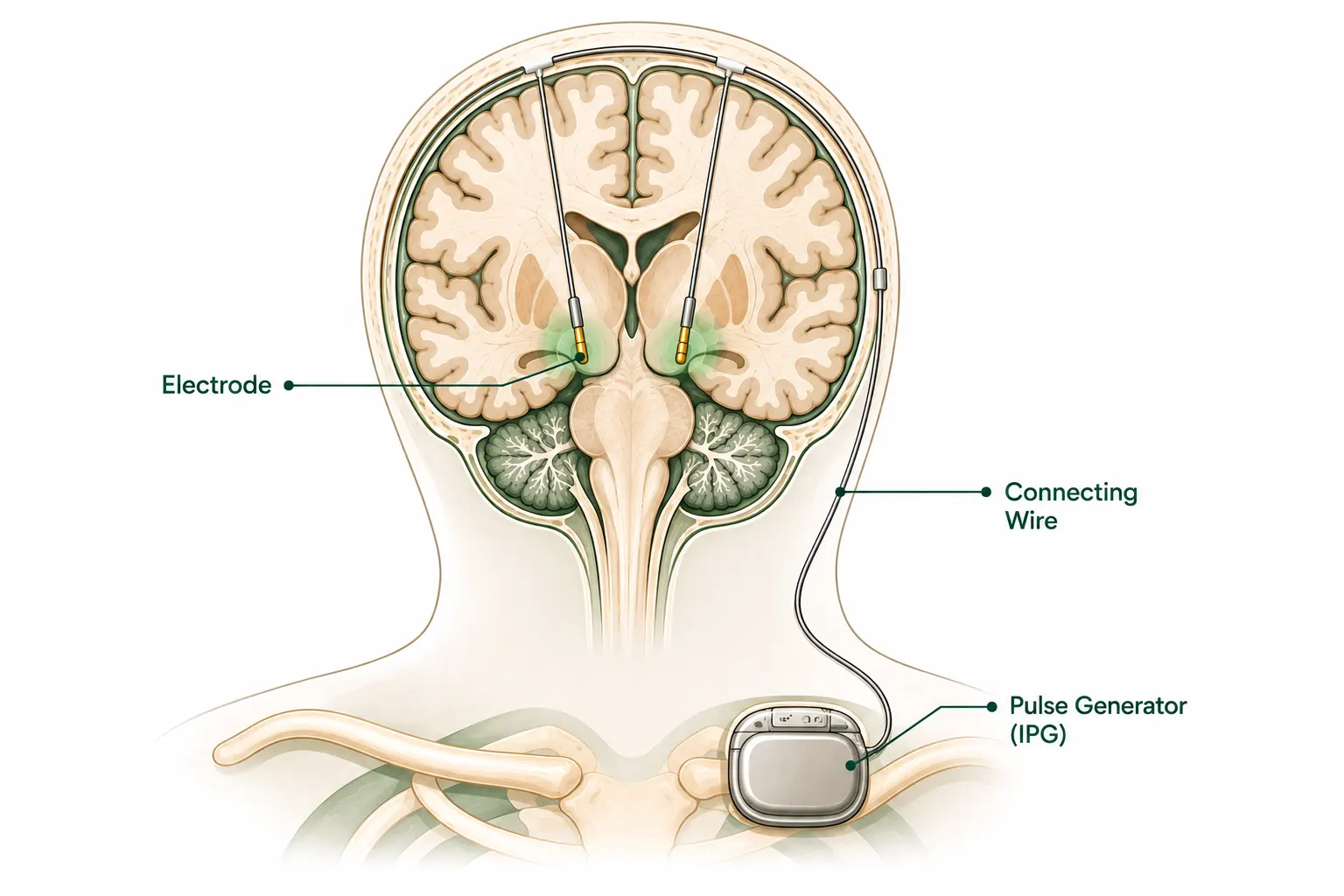
Deep Brain Stimulation (DBS) surgery in Delhi is a proven neurosurgical treatment for Parkinson’s disease, essential tremor, dystonia, and select cases of drug-resistant epilepsy. It works by placing thin electrodes in specific areas of the brain that regulate movement, connected to a small pulse generator that sends controlled electrical impulses to calm abnormal brain activity.
Dr. Vikas Gupta, Senior Consultant Neurosurgeon at Kailash Deepak Hospital, Karkardooma, brings over 30 years of neurosurgical experience to DBS planning, electrode placement, and long-term programming for patients across Delhi NCR.
Reach Out for Expert Care
What Is Deep Brain Stimulation (DBS) Surgery?
DBS surgery is a procedure that implants electrodes in targeted brain regions to deliver controlled electrical impulses, helping regulate the abnormal brain signals responsible for tremors, stiffness, and involuntary movements.
- The system has three parts: thin electrodes placed in the brain, a pulse generator (IPG) implanted under the skin near the collarbone, and a connecting wire.
- Impulses are adjusted externally, without further surgery, to match each patient’s symptoms.
- DBS does not cure the underlying disease; it manages symptoms that no longer respond adequately to medication.
DBS is reversible and adjustable, which is what makes it different from older lesioning surgeries that permanently altered brain tissue.
Which Conditions Does DBS Treat?
DBS is most commonly used for Parkinson’s disease, essential tremor, and dystonia, and in select cases for drug-resistant epilepsy.
- Parkinson’s Disease: Reduces tremor, rigidity, and slowness of movement (bradykinesia) once medication response becomes unpredictable.
- Essential Tremor: Controls disabling hand, arm, or head tremor that limits daily tasks like eating or writing.
- Dystonia: Eases the abnormal muscle contractions and postures that cause pain and functional difficulty.
- Drug-Resistant Epilepsy: Considered for focal seizures not controlled by medication and not suitable for resective surgery.
The right target and technique depend entirely on the specific condition and each patient’s symptom pattern.
Who is a Good Candidate for DBS Surgery?
Good candidates are patients whose symptoms are no longer adequately controlled by medication but who still respond to it, without significant cognitive or psychiatric complications.
- Parkinson’s patients with “on-off” medication fluctuations or dyskinesia
- Essential tremor patients where medication no longer controls symptoms
- Dystonia patients unresponsive to medication and botulinum toxin injections
- Absence of significant dementia or uncontrolled psychiatric illness
- Realistic expectations about symptom control rather than a cure
A detailed neurological assessment, imaging review, and often a levodopa response test are used to confirm candidacy before surgery is recommended.
DBS Surgery Procedure in Delhi
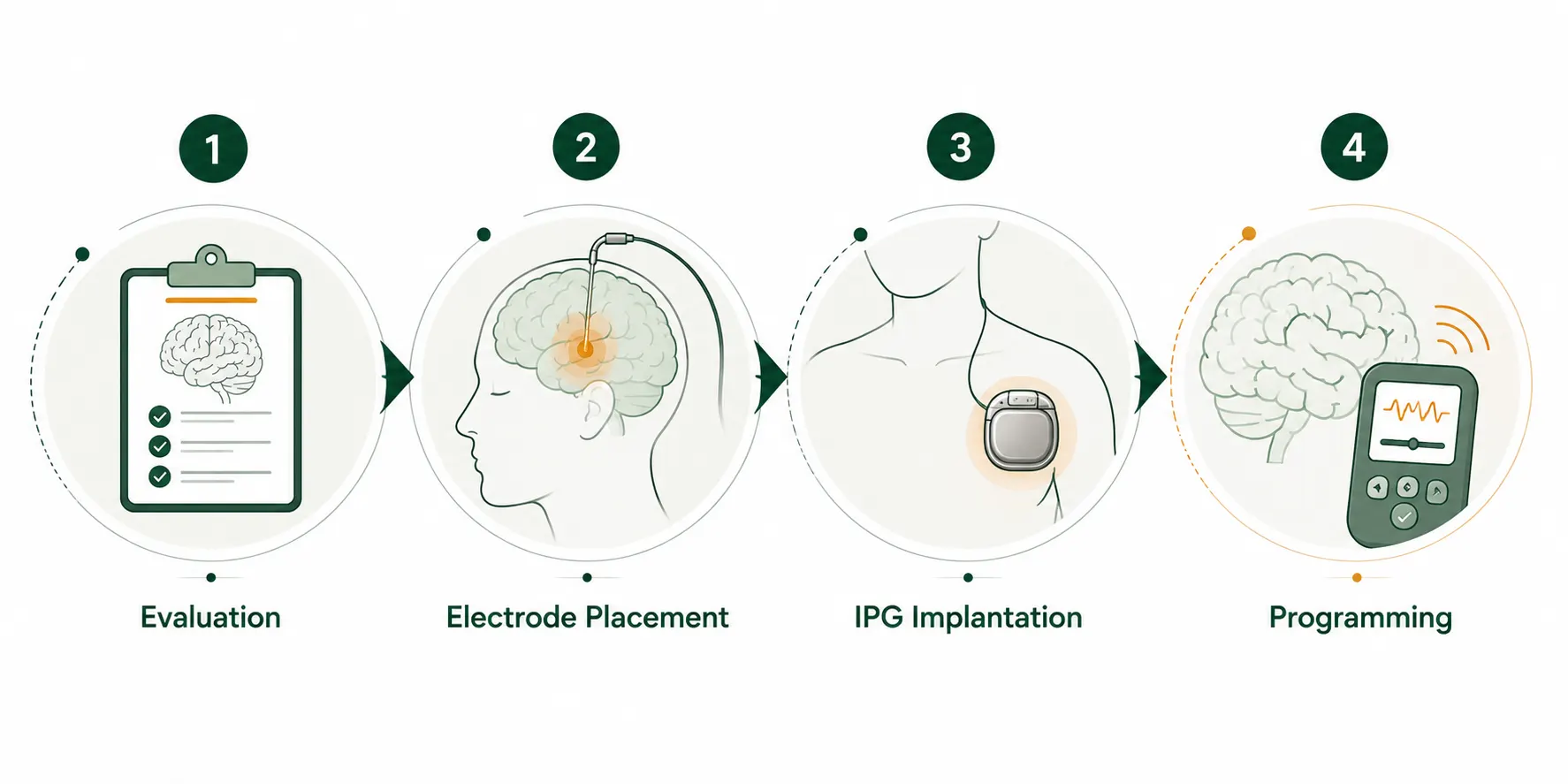
DBS surgery involves precise electrode placement under imaging guidance, followed by connection to a pulse generator implanted under the skin near the chest.
- Pre-Surgical Evaluation: MRI/CT-based brain mapping, neuropsychological assessment, and medication response testing to plan safe, accurate targeting.
- Electrode Placement: Thin electrodes are guided into precise brain targets using stereotactic and neuronavigation techniques, through a small opening in the skull.
- Pulse Generator Implantation: A small device is placed under the skin near the collarbone and connected to the electrodes through a thin wire under the skin.
- Programming: Stimulation settings are calibrated over subsequent visits to balance symptom control against side effects.
Most patients are awake or lightly sedated during electrode placement to allow real-time symptom testing, though technique varies by case.
What Are the Benefits and Risks of DBS Surgery?
DBS can meaningfully reduce tremor, stiffness, and involuntary movements, but like any brain surgery, it carries risks that should be discussed individually with a neurosurgeon.
Benefits:
- Reduced tremor, rigidity, and dyskinesia
- Lower medication requirements in many Parkinson’s patients
- Improved daily functioning and independence
- Stimulation settings can be adjusted non-invasively over time
Risks:
- Bleeding or infection at the surgical site
- Hardware-related issues (lead displacement, battery replacement)
- Temporary or, rarely, persistent changes in speech, mood, or cognition
- Stimulation-related side effects that usually improve with reprogramming
A frank discussion of individual risk factors, based on imaging and health status, is part of every DBS consultation with Dr. Gupta.
Recovery After DBS Surgery
Most patients are discharged within a few days of surgery, with stimulation settings fine-tuned gradually over the following weeks and months.
- Day 1-2: Monitoring in hospital after electrode and IPG placement
- Week 1-2: Wound healing; rest with restricted strenuous activity
- Week 2-4: Device activation and initial programming begins
- Months 1-6: Regular follow-up visits to adjust stimulation and medication together
Full symptom benefit is usually seen only after several rounds of programming, not immediately after surgery.
DBS Surgery Cost in Delhi
The cost of DBS surgery in Delhi depends on the type of device (rechargeable or non-rechargeable), the number of electrodes required, hospital stay, and post-operative programming visits. Key factors that influence the cost:
- Type and brand of neurostimulator device used
- Unilateral vs bilateral electrode placement
- Pre-surgical imaging and evaluation (MRI, neuropsychological testing)
- ICU care and length of hospital stay
- Number of post-operative programming sessions required
A personalised consultation, including a review of imaging and current medication response, is needed to provide an accurate DBS surgery cost estimate.
Why Choose Dr. Vikas Gupta for DBS Surgery in Delhi?
Dr. Vikas Gupta brings over 30 years of neurosurgical experience and 5,000+ surgeries performed to the planning, placement, and long-term management of DBS therapy.
- 30+ years of neurosurgical experience across complex and emergency neurological conditions
- 5,000+ surgeries performed, with hands-on expertise in stereotactic and functional neurosurgery
- Personalised, condition-specific treatment planning rather than a one-size-fits-all protocol
- Ongoing, transparent programming support for patients across Karkardooma, Anand Vihar, East Delhi, and Delhi NCR
Book a Consultation for DBS Surgery in Delhi
DBS is a significant decision, and the right evaluation matters as much as the surgery itself. During your consultation with Dr. Vikas Gupta, you can expect:
- Review of your neurological history and current medication response
- MRI/CT-based assessment of DBS suitability
- Explanation of expected benefits, realistic limitations, and risks
- A clear walkthrough of the surgical process and recovery timeline
- Transparent discussion of costs and programming follow-up
Frequently Asked Questions
Is DBS surgery only for Parkinson's disease? expand_more
No. While Parkinson's disease is the most common indication, DBS is also used for essential tremor, dystonia, and select cases of drug-resistant epilepsy.
Does DBS replace the need for medication? expand_more
Not entirely. Many patients need lower medication doses after DBS, but most continue some medication alongside stimulation.
Is DBS surgery reversible? expand_more
The stimulation can be turned off or adjusted at any time. The device and leads can also be surgically removed if required, making DBS more adjustable than older lesioning procedures.
Who is the best neurosurgeon in Delhi? expand_more
Dr. Vikas Gupta brings 30+ years of neurosurgical experience and has performed 5,000+ surgeries, making him a trusted and experienced choice for glioma evaluation and treatment in Delhi NCR.
How can I book an appointment with Dr. Vikas Gupta? expand_more
You can book an appointment with Dr. Vikas Gupta by contacting us directly or using our online appointment booking facilities available on this website.

Dr. Vikas Gupta’s Medical Content Team
Dr. Vikas Gupta’s medical content team specialises in creating accurate, clear, and patient-focused healthcare content. With strong clinical understanding and expertise in technical writing and SEO, the team translates complex medical information into reliable, accessible resources that support informed decisions and uphold Dr. Gupta’s commitment to quality care.
This content is reviewed by Dr. Vikas Gupta
Related Blogs
 WhatsApp