Stroke Awareness Webinar 2026: Dr. Vikas Gupta
On 24 October 2026, from 5:30 pm to 6:30 pm, Dr. Vikas Gupta, Senior Consultant Neurosurgeon and Neurointerventional Specialist at Kailash Deepak Hospital, Delhi, hosted a live stroke awareness webinar. His core message: stroke is an emergency, the person affected often cannot ask for help, and family members or bystanders decide how fast treatment begins. Here are the key lessons in plain language.
What Was the Stroke Webinar by Dr. Vikas Gupta About?
The webinar taught families how to recognise a stroke, why the first hours decide recovery, what causes it, how hospitals treat it and how patients rebuild life afterwards.
- The brain uses about 20% of the body’s oxygen and receives about 25% of the heart’s blood, so even a short blockage causes damage.
- According to the Indian Stroke Association, a stroke occurs every 20 seconds in India, with over 18 lakh new cases each year.
- A national registry cited in the talk found 1 in 7 stroke patients in India is under 45.
- Stroke has many names: paralysis, adrangh, phaliz, lakwa and cerebrovascular accident (CVA).
Stroke is common and often recognised late, which is why awareness saves lives.
How Do You Recognise a Stroke? (BE FAST)
Remember BE FAST: sudden loss of Balance, trouble with Eyesight, Face drooping, Arm weakness, Speech difficulty, then Time to call for emergency help immediately.
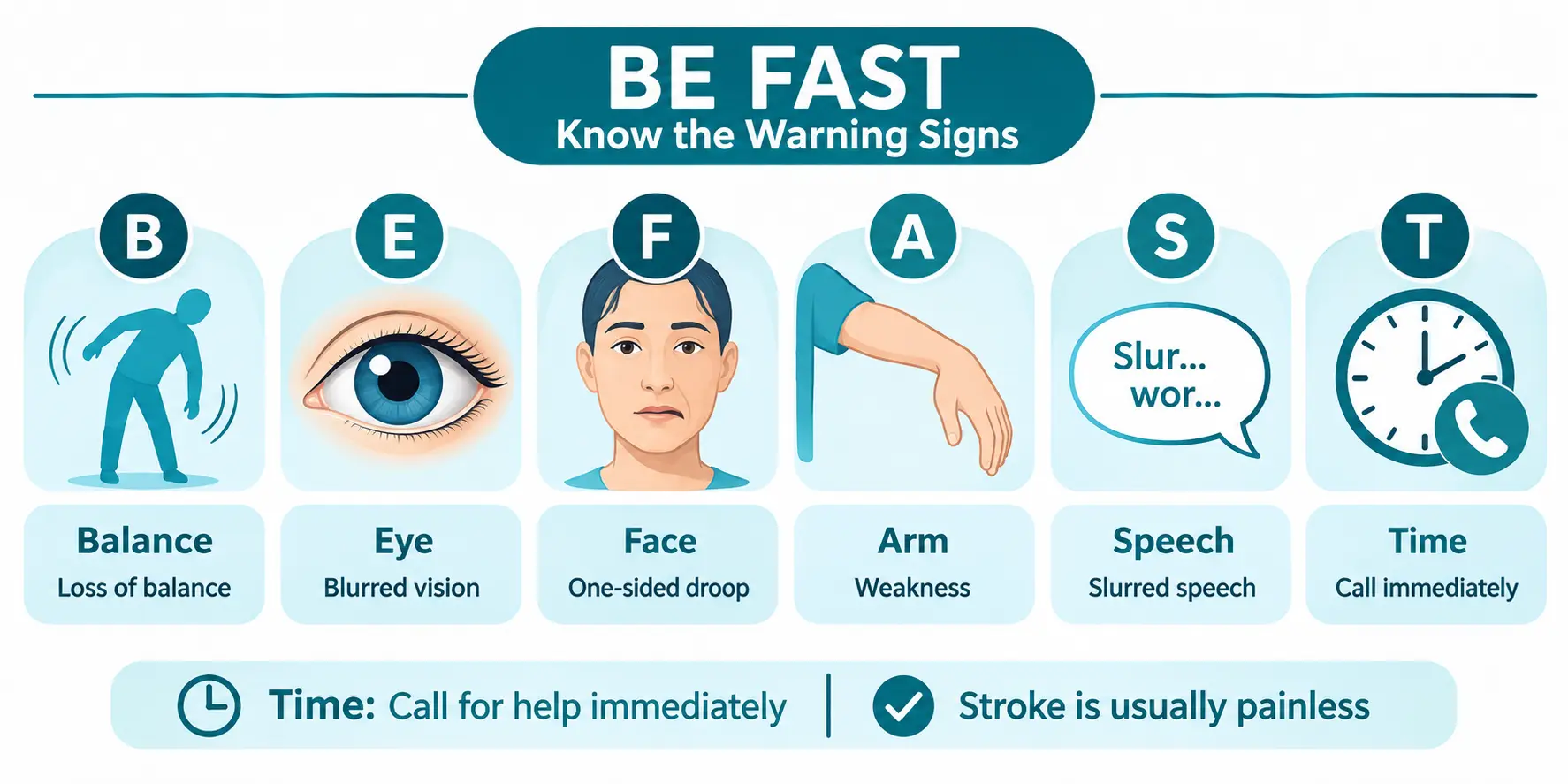
- Balance: sudden dizziness or unsteady walking.
- Eyes: sudden blurred, double or lost vision.
- Face: one side droops when smiling.
- Arm: one arm or leg is weak or numb.
- Speech: slurred, confused or lost speech.
- Time: Call at once.
- Stroke is usually painless, so families wrongly “wait and watch” at home.
A bystander who recognises these signs is often the first step of treatment.
Why Is the Golden Hour So Important in Stroke?
About 1.9 million brain cells die every minute a stroke goes untreated. Clot-dissolving medicine is usually given within 4.5 hours, and clot removal can help selected patients for longer.
- Note when symptoms began, or when the person was last seen normal.
- Do not give aspirin or blood pressure tablets. Blood pressure rises during any stroke, and the cause may be a bleed.
- Do not wait for relatives; go straight to a hospital with CT scan, cath lab and a neurosurgeon.
- The 2026 American Heart Association/American Stroke Association guideline supports tenecteplase or alteplase within 4.5 hours, selected treatment up to 9 hours with advanced imaging, and thrombectomy in selected patients up to 24 hours.
The golden hour is a call to act immediately, not a deadline after which nothing can be done.
What Raises the Risk of Stroke?
The main stroke risk factors are high blood pressure, diabetes, high cholesterol, tobacco, obesity, inactivity and excess alcohol. Most are silent, which is why hypertension and diabetes were called “silent killers.”
- High blood pressure and high sugar damage artery walls; fatty deposits then narrow the vessel until a clot blocks it.
- Tobacco harms blood vessels and makes clots more likely.
- Delhi’s winter pollution adds risk for older adults, smokers and people with hypertension, diabetes or a past stroke. Check the daily AQI, avoid strenuous outdoor exercise on high-pollution days and wear a well-fitting N95 mask.
- Family history matters most if a parent or sibling had an early stroke, or aneurysms run in the family. Read about brain aneurysm treatment.
Knowing your blood pressure, sugar and cholesterol numbers is the simplest protection.
How Is Stroke Confirmed and Treated in Hospital?
A non-contrast CT scan is usually the first test, showing within minutes whether the stroke is a blockage or a bleed. MRI adds detail, and treatment depends on type, timing and clot size.
- The team checks neurological deficits, then orders CT or MRI with angiography.
- For large-vessel clots, mechanical thrombectomy removes the clot through a catheter, generally within about 6 hours and in selected patients up to 24 hours.
- For a ruptured aneurysm, aneurysm coiling guides a catheter to the weak bulge in the artery wall and fills it with fine platinum coils, so blood stops entering it and the risk of re-bleeding falls.
- For severe brain swelling, decompressive hemicraniectomy removes part of the skull on one side to give the swollen brain room and ease dangerous pressure. It is open surgery, not a catheter procedure.
- Not every brain haemorrhage needs surgery; it depends on the type and location of the bleed. See brain haemorrhage treatment.
- Families receive the likely benefits and risks upfront. Planning ahead? See stroke treatment cost in Delhi.
The right test, at the right hospital, at the right time, shapes the outcome.
What Does Recovery After Stroke Look Like?
Some people recover very well while others have lasting difficulties. Early treatment, structured rehabilitation and steady family support improve recovery.
- A rehabilitation team includes physiotherapists, occupational and speech therapists, neuropsychologists and orthotics care.
- Stroke can also affect mood, memory, swallowing and bladder control, so a loved one may seem different.
- Families can help by staying patient, avoiding blame, keeping a calm home, encouraging gradual daily activity and reporting persistent mood changes to the doctor.
Recovery takes sustained effort from the whole family.
How Can You Prevent a Stroke?
Control blood pressure, sugar and cholesterol, avoid tobacco, stay active, eat a heart-healthy diet, limit alcohol and keep regular check-ups.
- Take blood pressure and diabetes medicines regularly; never stop them because readings look normal.
- Get a lipid profile done; choose vegetables, fruits, whole grains and nuts over fried or processed food.
- Aim for at least 150 minutes of activity weekly and a healthy weight.
- After a stroke, medicines and follow-up lower the chance of another. Carotid blockage is one cause; see carotid artery disease.
Small daily choices today lower stroke risk tomorrow.
Frequently Asked Questions
Can stroke symptoms disappear on their own? expand_more
Yes, sometimes. This may be a transient ischaemic attack (TIA), or “mini-stroke,” and it is still an emergency because it can warn of a larger stroke.
Can a stroke happen again? expand_more
Yes, but medicines, blood pressure and sugar control, healthy habits and follow-up reduce the risk.
Why did I have a stroke with no warning signs? expand_more
High blood pressure, diabetes, cholesterol, irregular heartbeat and smoking can damage vessels silently.
Can a person recover completely after stroke? expand_more
It varies. Early treatment and rehabilitation improve recovery.

 WhatsApp