
How to Strengthen Nervous System: Best Exercises & Neuro Balance Plan

Many people ask how to strengthen nervous system health after months of stress, an injury, or a worrying neurological diagnosis. The encouraging news is that your brain and nerves can keep adapting at any age when you move regularly, sleep well, and eat right. This guide covers the best exercises for nervous system support, a beginner-friendly neuro balance plan, and the warning signs that need a specialist. It is prepared for patients of Dr. Vikas Gupta, Senior Consultant Neurosurgeon at Kailash Deepak Hospital, Karkardooma, Delhi.
Reach Out for Expert Care
Can You Really Strengthen Your Nervous System?
Yes, to a large extent. You cannot “build” nerves the way you build muscle, but regular exercise, sleep, and good nutrition improve neuroplasticity, which is the brain’s ability to form new connections and help nerves work efficiently.
- Aerobic exercise raises BDNF, a protein that supports nerve cell survival and connections. A meta-analysis found that regular aerobic exercise programmes increased BDNF levels in people with neurological disorders, although the studies were of low quality.
- Balance and coordination drills train the brain and body to communicate faster.
- Exercise supports recovery but cannot repair a damaged nerve, a spinal injury, or a tumour on its own.
Think of exercise as support for your nervous system, never a replacement for medical care.
How to Strengthen Nervous System Naturally: 6 Daily Habits
To strengthen your nervous system naturally, combine daily movement, 7 to 8 hours of sleep, nutrient-rich food, stress control, and regular mental challenges.
- Sleep well: the brain repairs itself and stores memories during deep sleep. Persistent poor sleep may need a check-up for sleep disorders.
- Eat to strengthen nerves: include vitamin B12 (eggs, dairy, fortified foods), omega-3 (walnuts, flaxseed, fish), magnesium (nuts, leafy greens), and antioxidant fruits such as amla and berries.
- Check your B12: many vegetarians in India run low, and deficiency can cause tingling and numbness. Ask your doctor for a blood test before taking supplements.
- Control stress: chronic stress keeps the nervous system in “fight or flight” mode.
- Challenge your brain: learn a language, play chess, or try a new route.
- Avoid smoking and limit alcohol: both damage nerves and blood vessels.
Small, consistent habits protect your nerves far better than occasional extreme efforts.
Best Exercises for Nervous System Health
The best exercises for nervous system health are aerobic activity, balance drills, strength training, coordination games, and gentle yoga or tai chi. A mix works better than any single exercise.
- Brisk walking, cycling, or swimming: 30 minutes, 3 to 5 days a week, boosts blood flow and BDNF.
- Single-leg stand: hold 30 seconds per leg near a wall or sturdy chair to train balance.
- Heel-to-toe walking: walk in a straight line, placing one heel directly in front of the other toes.
- Strength training: squats, wall push-ups, and resistance bands twice a week support the nerve-muscle connection.
- Coordination games: ball tossing, skipping, or dance steps challenge brain and body together.
- Yoga or tai chi: slow movements improve balance, posture, and calm.
- Delhi tip: on high-AQI days, exercise indoors instead of outside.
Start gently, stay near support, and stop if you feel dizzy, weak, or short of breath.
Neuro Balance Plan for Beginners: A 4-Week Routine
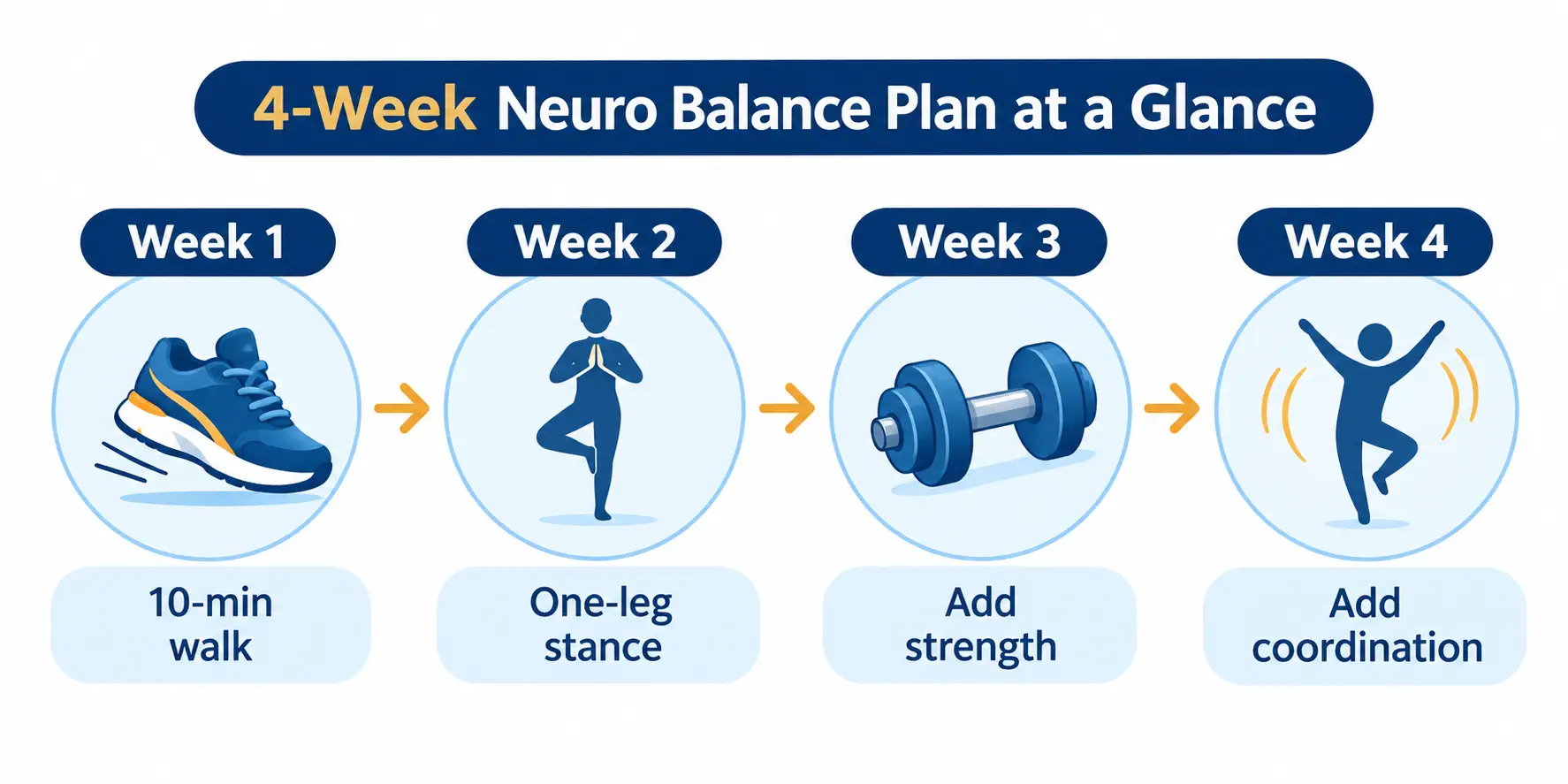
A beginner neuro balance plan starts with 10 minutes of daily walking, simple balance drills, and slow breathing, then builds to 30 minutes of mixed activity by week four.
- Week 1: 10-minute walk, single-leg stand (3 rounds of 30 seconds per side), and 5 minutes of slow breathing.
- Week 2: 20-minute walk, 2 minutes of heel-to-toe walking, and single-leg stand with a light fingertip on a wall.
- Week 3: 30-minute brisk walk on three days, plus two short strength sessions (squats and wall push-ups).
- Week 4: add 10 minutes of coordination (ball toss or dance) and one yoga or tai chi session.
- Every week: sleep 7 to 8 hours, drink enough water, and note your progress, such as balance time or energy level.
Consistency matters more than intensity, so repeat any week until it feels comfortable.
Nervous System Exercises for Stress Relief
A simple nervous system exercise for stress is slow diaphragmatic breathing: inhale for 4 seconds, exhale for 6 seconds, for 5 minutes. Longer exhales help switch on your body’s rest-and-digest response.
- Diaphragmatic breathing: place a hand on your belly and let it rise as you inhale.
- Progressive muscle relaxation: tighten and release each muscle group from toes to face.
- Humming or gentle chanting: slow, vibrating exhales may help the body settle.
- Unplugging: take 10 minutes without screens, ideally outdoors in daylight.
Practice twice daily, because nervous system exercises work best as a habit.
Habits That Weaken Your Nervous System
Chronic sleep loss, smoking, alcohol, inactivity, untreated diabetes, and poor posture are the habits that most often weaken nervous system health.
- Uncontrolled diabetes and blood pressure damage nerves and brain blood vessels.
- Long hours bent over screens strain the neck; read about cervical spondylosis and its warning signs.
- Ignoring tingling or numbness can delay diagnosis of nerve compression such as carpal tunnel syndrome.
- Skipping meals and crash diets can cause nutrient deficiencies.
Fixing these basics protects your nerves before problems begin.
When to See a Neurosurgeon in Delhi
If you are searching for the best neurosurgeon in Delhi, keep this in mind: see a specialist as soon as you notice persistent numbness, weakness, severe headaches, loss of balance, or seizures. Exercise cannot treat structural nerve, spine, or brain conditions, and early assessment can prevent lasting damage.
- Sudden face drooping, arm weakness, or slurred speech: treat this as an emergency and go to the nearest hospital at once. India’s national stroke registry programme, run by ICMR, recorded about 138 new strokes per 100,000 people a year in 2018-2019. Stroke is now the fourth leading cause of death in India. Learn more about stroke treatment in Karkardooma. Stroke incidence, mortality, subtypes in rural and urban populations in five geographic areas of India +2
- Recurring seizures: may need a detailed evaluation for epilepsy treatment in Delhi. About 10 million people in India live with epilepsy, and the share who go untreated ranges from 22% in urban areas to 90% in villages. Seeking help early closes that gap. (nih)
- Memory changes: may need assessment for Alzheimer’s treatment in Delhi. A national study estimates that 7.4% of Indians over 60, roughly 8.8 million people, live with dementia. (nih)
- Back pain with leg weakness: may signal lumbar spondylosis or a disc problem.
- Arm weakness after an injury: may need evaluation for brachial plexus and nerve surgery.
When choosing a neurosurgeon, look for long hands-on experience, a hospital with a dedicated neuro-ICU, and a doctor who explains your options clearly. Dr. Vikas Gupta, with over 30 years of neurosurgical experience at Kailash Deepak Hospital, Karkardooma, may help you get the right diagnosis and the most suitable treatment.
Sources:
ICMR–NCDIR – Stroke Incidence, Mortality and Subtypes in Five Areas of India
Annals of Indian Academy of Neurology – Epilepsy in India: Epidemiology and Treatment Gap
Alzheimer’s & Dementia – Prevalence of Dementia in India: National and State Estimates (LASI-DAD)

 WhatsApp