
Brain Aneurysms: What Are its Causes, Symptoms, and Treatment?
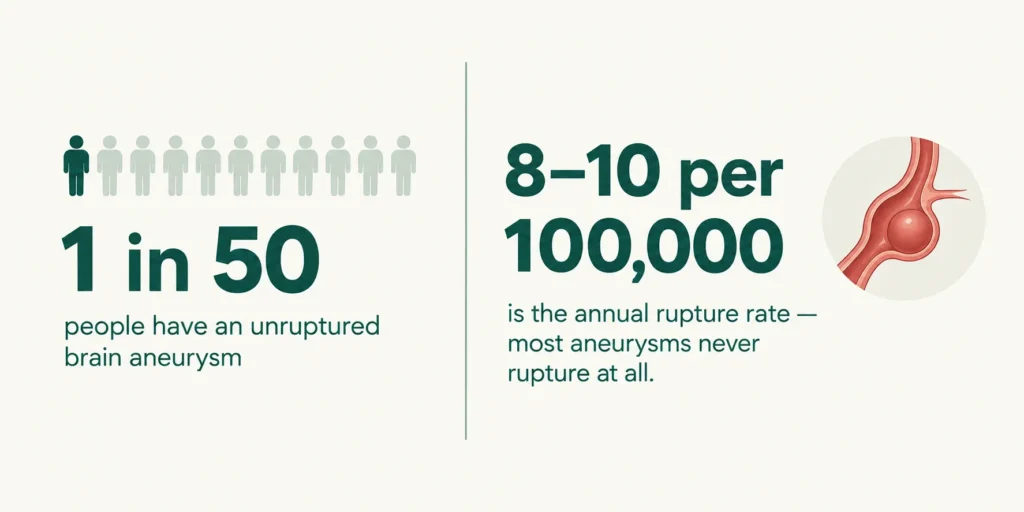
When people picture a brain aneurysm, they usually imagine the worst-case version straightaway: a sudden collapse, an ambulance, an emergency room. That version exists, and it’s serious, but it’s not the whole story.
Here’s the part most people don’t know: a brain aneurysm can sit quietly inside a blood vessel for years, causing no symptoms at all, until it’s found completely by accident, on a scan ordered for something else entirely, a headache, a dizzy spell, a routine check after a minor fall. By the time it’s spotted, it may have been there for a decade.
That’s what makes aneurysms worth understanding before they become an emergency, not after.
Reach Out for Expert Care
What Is a Brain Aneurysm, Really?
Think of a blood vessel wall as a length of hose. Most of it is strong and even. But at one point, usually where the vessel branches, the wall can be thinner than it should be. Blood pressure pushes against that thin spot, and over time, it bulges outward, like a weak patch on the hose ballooning under pressure.
That bulge is the aneurysm.
Most stay small and never cause a problem. A minority grow large enough to press on nearby nerves, or, in the more serious cases, weaken further and tear, causing bleeding inside the brain. The size of the aneurysm at diagnosis matters, but so does its location, its shape, and how it behaves on repeat scans.
Brain Aneurysm Symptoms: “But I Had No Idea It Was There”
This is the sentence Dr. Vikas Gupta hears often from patients. An unruptured aneurysm, in most cases, gives no warning at all. It’s discovered on an MRI done for migraines, or a CT scan after a car accident, and the patient is stunned to learn it’s been sitting there, possibly for years.
Occasionally, if the aneurysm grows large enough to press on a nerve, subtle clues do appear:
- Pain behind or above one eye that doesn’t quite fit a normal headache
- A drooping eyelid on one side
- Blurred or double vision
- Numbness or a strange weakness on one side of the face
These signs are easy to dismiss as tiredness or eye strain, which is exactly the problem.
A ruptured aneurysm is a different story altogether, and there’s no ambiguity about it. It causes a sudden, severe headache that people almost universally describe as the worst of their life, often with vomiting, neck stiffness, sensitivity to light, and sometimes confusion or loss of consciousness.
This is a genuine emergency. There is no “wait and see” with a suspected rupture, the only right response is to get to a hospital immediately.
What Puts Someone at Risk?: Brain Aneurysm Risk Factors
Just like with strokes, aneurysm risk builds quietly, through conditions that wear down blood vessel walls over months and years rather than overnight.
The factors that come up again and again include:
- Long-standing high blood pressure, which places continuous strain on vessel walls
- Smoking, which weakens vessel walls and accelerates their breakdown
- A family history of brain aneurysms, particularly in first-degree relatives
- Atherosclerosis, or fatty plaque buildup narrowing the arteries
- Head injury or trauma
- Certain connective tissue or blood vessel disorders
- Heavy alcohol use
Most patients have at least one of these factors. Some have none at all. That unpredictability is precisely why family history and incidental findings on scans deserve to be taken seriously, even when nothing feels wrong.
Brain Aneurysm Diagnosis: How Do You Actually Find One?
An aneurysm doesn’t show up on a routine blood test or a physical exam. It’s found through imaging, and the specific scan matters.
A CT scan is usually the first step, especially in an emergency, because it can quickly reveal bleeding, but for mapping the aneurysm itself, its size, shape, and exact position, an MRI or MR angiography gives far more detail. For surgical planning, Dr. Gupta often relies on CT or digital subtraction angiography (DSA), which remains the most precise way to visualise the blood vessels before deciding on treatment.
As Dr. Gupta puts it, “An aneurysm found early, before it ruptures, gives us far more options and far better odds than one found in an emergency.”
Brain Aneurysm Treatment: What Actually Happens Next?
Treatment isn’t one-size-fits-all, and this is where an experienced neurosurgeon’s judgment matters most.
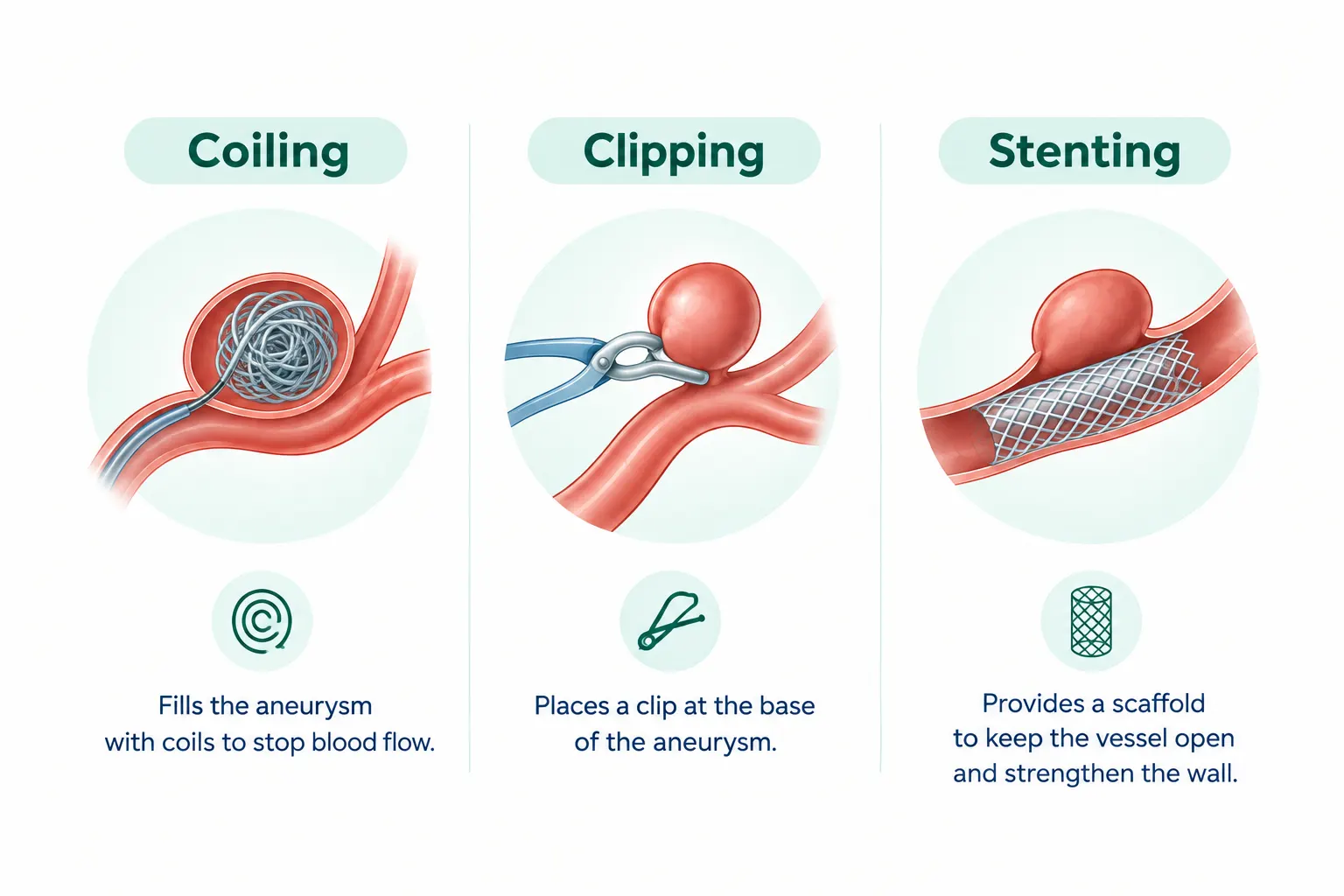
For many patients, endovascular coiling is the preferred route. A catheter is guided from the groin up to the aneurysm, and soft platinum coils are packed inside it to trigger clotting and seal it off. No skull opening is needed, and recovery is typically faster.
For aneurysms in more accessible or complex locations, surgical clipping remains highly effective. A small section of the skull is opened, and a metal clip is placed at the base of the aneurysm, cutting it off from blood flow permanently.
In select cases, a stent is used to redirect blood flow away from the weakened vessel wall, sometimes alongside coiling for added support.
One patient, recalling her own diagnosis, put it simply: “I found out about my aneurysm completely by chance, a scan for something unrelated. I was terrified at first, but once the coiling procedure was explained to me step by step, it felt far less frightening. I was walking around within a day.”
Cost is naturally one of the first questions families ask. In Delhi, brain aneurysm treatment typically falls somewhere between ₹4.5 lakh and ₹12 lakh, depending on whether coiling, clipping, or stenting is used, and how complex the case is. A precise figure only comes after imaging and evaluation, since every aneurysm genuinely is different.
Conclusion
A brain aneurysm can sound alarming, but most are manageable when caught early and treated by an experienced neurosurgical team. Whether it’s watchful monitoring, endovascular coiling, clipping, or stenting, today’s treatments are safer and less invasive than ever.
An aneurysm rarely announces itself the way people expect. It doesn’t always come with dramatic symptoms, and that’s exactly why it deserves more attention, not less.
If you have a family history of aneurysms, unexplained eye pain or vision changes, or if a scan done for another reason has flagged something unusual, it’s worth having it properly evaluated rather than filed away as “probably nothing.” And if you ever experience a sudden, severe headache unlike anything you’ve had before, treat it as the emergency it is.
As Dr. Gupta often tells his patients, “The bulge itself isn’t what determines the outcome, catching it in time is.” For those exploring related vascular conditions of the brain, our page on Brain AVM treatment in Delhi covers another form of abnormal blood vessel growth worth understanding.
Brain health rarely shouts before it whispers. Paying attention to that whisper is often the difference between a manageable diagnosis and a crisis.

 WhatsApp