
Time Is Brain: Mechanical Thrombectomy Reverses a Stroke in Under 30 Minutes
A 65-year-old woman was getting ready for her morning routine when her family noticed something was wrong, her face had suddenly changed shape, her speech was slurred, and she couldn’t walk properly.
Within the hour, she was in the emergency room, under the care of senior consultant neurosurgeon Dr Vikas Gupta. Twenty-eight minutes later, a blocked brain artery had been reopened, and she was moving her right side again, on the operating table, before the procedure had even ended.
This is her story, and why every family in Delhi NCR should know it.
Reach Out for Expert Care
What Happened in the Emergency Room That Morning?
The patient arrived with sudden facial asymmetry, slurred speech, and right-sided weakness, the three cardinal signs of an acute stroke, and was taken for emergency imaging within minutes of arrival.
- Family members noticed the sudden change immediately after she woke up and completed her morning routine
- She was rushed to the emergency room by 7:30 am, well within the critical treatment window
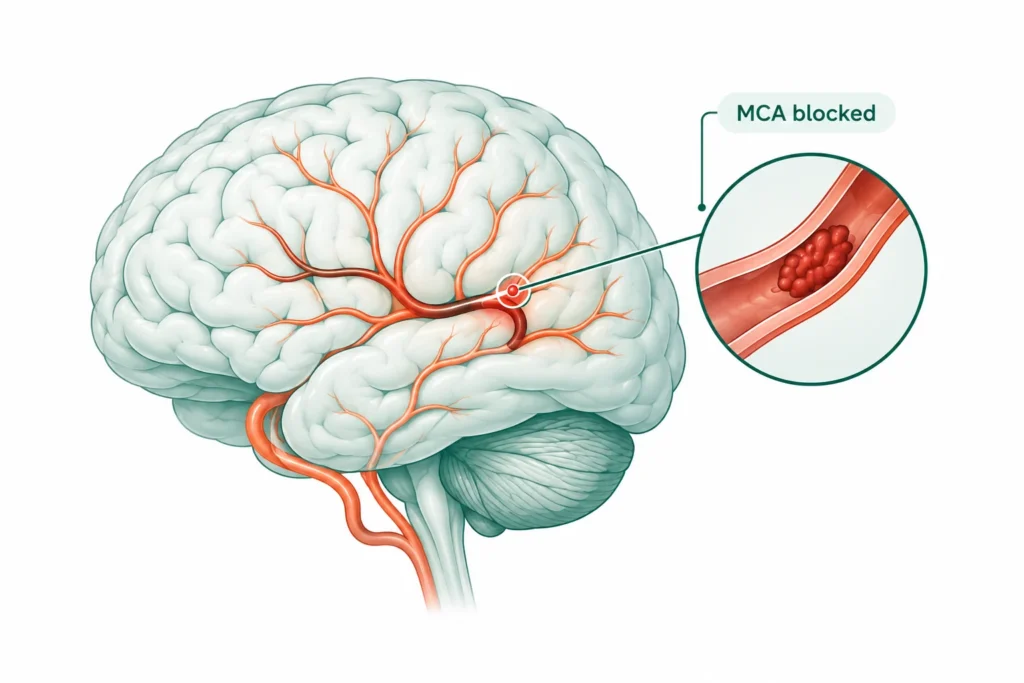
- Emergency CT and vascular imaging confirmed a blockage in the middle cerebral artery (MCA), one of the brain’s major blood supply routes
- Dr Vikas Gupta personally counselled the husband on the urgency, and he consented rapidly to emergency intervention
Recognising the signs early and reaching a stroke-ready hospital without delay is what made every next step possible.
What Is Mechanical Thrombectomy, and How Did It Save Her?
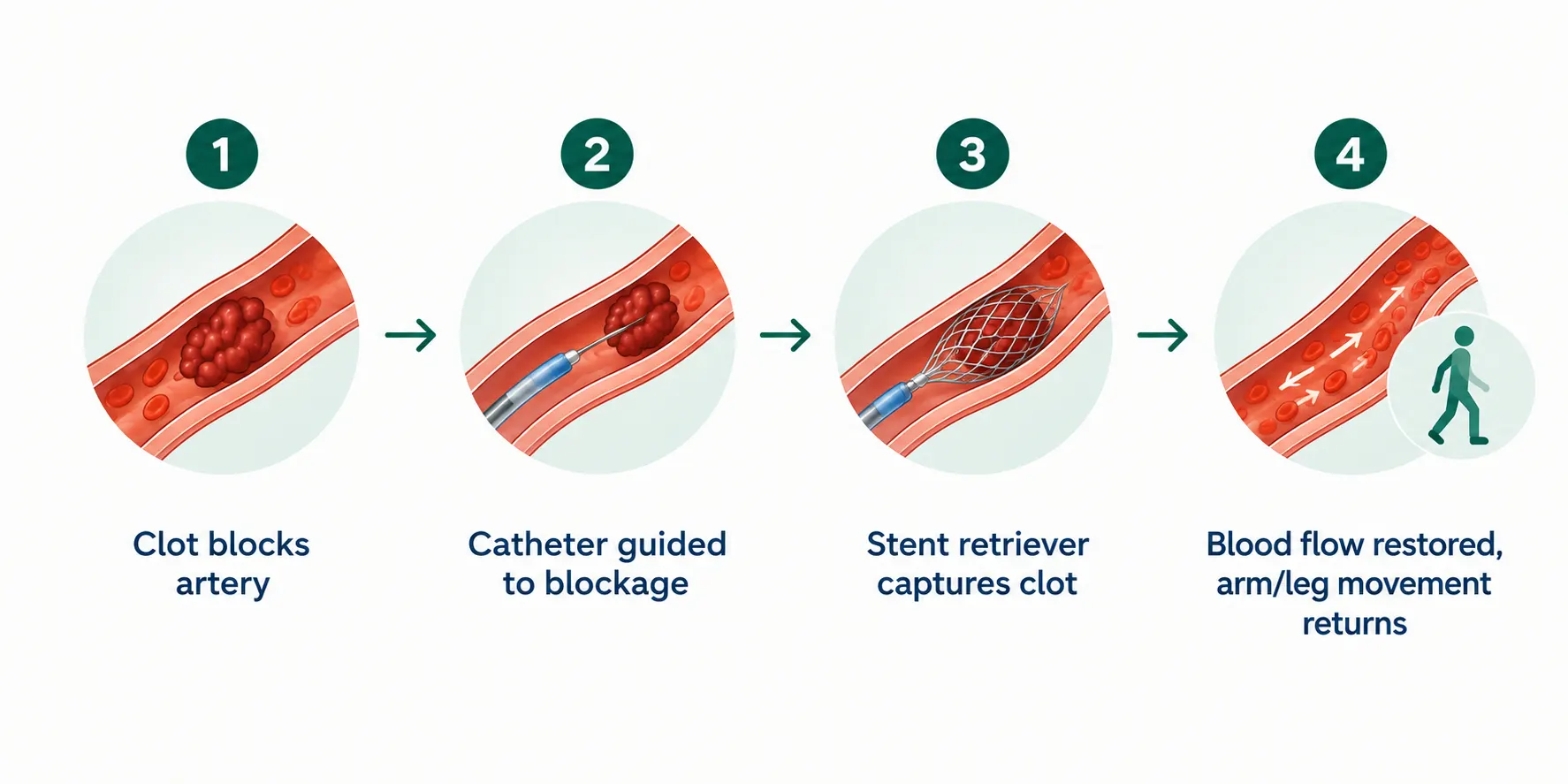
Mechanical thrombectomy is a minimally invasive, catheter-based procedure that physically removes a blood clot from a blocked brain artery using a device called a stent retriever, restoring blood flow without any incision, general anaesthesia, or clot-dissolving drugs.
- The patient was taken directly to the neurovascular cath lab, where Dr Vikas Gupta led the procedure
- A thin catheter carrying a stent retriever was guided through the blood vessels to the blocked MCA
- The device captured and withdrew the clot, reopening the artery in under 30 minutes from the start of the procedure
- No general anaesthesia and no additional clot-dissolving medication were required
- She regained movement on her right side while still on the procedure table
This is the same technology used worldwide for large vessel occlusion strokes, and Dr Vikas Gupta performs it as part of his neurointerventional practice in Delhi NCR. You can read more about the Thrombectomy for Stroke procedure in Delhi.
Why Does “Time Is Brain” Matter So Much?
Unlike a blocked heart artery, a blocked brain artery causes permanent, irreversible damage to brain tissue every minute it stays closed, which is why doctors say brain arteries must be reopened within 8 hours of symptom onset for a meaningful clinical recovery.
- Every minute of delay destroys roughly 1.9 million brain cells, according to global stroke research
- Brain tissue has far less tolerance for reduced blood flow than heart muscle
- Treatment started earlier in the window consistently produces better speech, movement, and independence outcomes
- Beyond the safe window, the same procedure carries higher risk and lower benefit
This is why recognising symptoms the moment they appear, and reaching a stroke centre without any delay, is often more important than which hospital is closest to home.
Stroke Warning Signs You Should Never Ignore
The warning signs of stroke include sudden facial drooping, weakness in an arm or leg, slurred or difficult speech, and blurred or lost vision, and anyone noticing these signs in themselves or another person should call for emergency help immediately, without waiting to see if symptoms pass.
- Sudden asymmetry or drooping on one side of the face
- Sudden weakness or numbness in the arm, leg, or one side of the body
- Slurred speech, difficulty finding words, or trouble understanding others
- Sudden blurred, double, or lost vision
- Sudden severe headache, dizziness, or loss of balance with no clear cause
Bystanders matter as much as family, anyone nearby who notices these signs should act immediately, because according to the World Stroke Organization, roughly 1 in 6 people will experience a stroke in their lifetime. For related warning symptoms that can precede a full stroke, see Transient Ischaemic Attack (TIA) Care in Delhi.
How Big Is the Stroke Burden in India?
Government data shows that a stroke occurs in India roughly every minute, and stroke is now recognised as a “brain attack” that requires the same emergency urgency as a heart attack, yet public awareness of its warning signs remains low.
- Indian government health data estimates around 800 strokes occurring across the country every minute of every day
- The American Stroke Association classifies endovascular thrombectomy for large vessel occlusion stroke as Class 1 evidence, its strongest level of recommendation
- Nearly all strokes are treatable when patients reach a stroke-ready centre in time
- The single biggest barrier to better outcomes is not access to technology, but delayed recognition of symptoms
Closing this awareness gap, one family at a time, is exactly why cases like this one are shared. Learn more about Stroke Treatment in Karkardooma and related Brain Haemorrhage Treatment in Delhi.
What Made This Outcome Possible?
Reversing a stroke this quickly depends less on any single moment and more on having an experienced neurointerventional team that can move from diagnosis to treatment without delay, something that comes from years of handling brain emergencies under pressure.
- Recognising a large vessel occlusion on imaging quickly enough to act within the critical window
- Years of hands-on experience across endovascular, microsurgical, and emergency neurovascular techniques, which shapes how fast and how safely a clot can be retrieved
- A clear, calm explanation to the family in the middle of a crisis, so consent and next steps aren’t delayed by confusion
- Coordination between imaging, the cath lab, and the surgical team happening almost simultaneously rather than in sequence
The procedure was led by Dr Vikas Gupta, a senior consultant neurosurgeon with over 30 years of experience in neurosurgical and neurointerventional care. That depth of experience is often what separates a stroke that’s caught in time from one that isn’t, outcomes like this reflect a team that has done this often enough to move fast without cutting corners.
If a loved one shows any stroke warning sign, don’t wait to see if it passes, reach a stroke-ready emergency room immediately.

 WhatsApp