
Right MMA Embolisation for Acute on Chronic Subdural Haematoma with Midline Shift
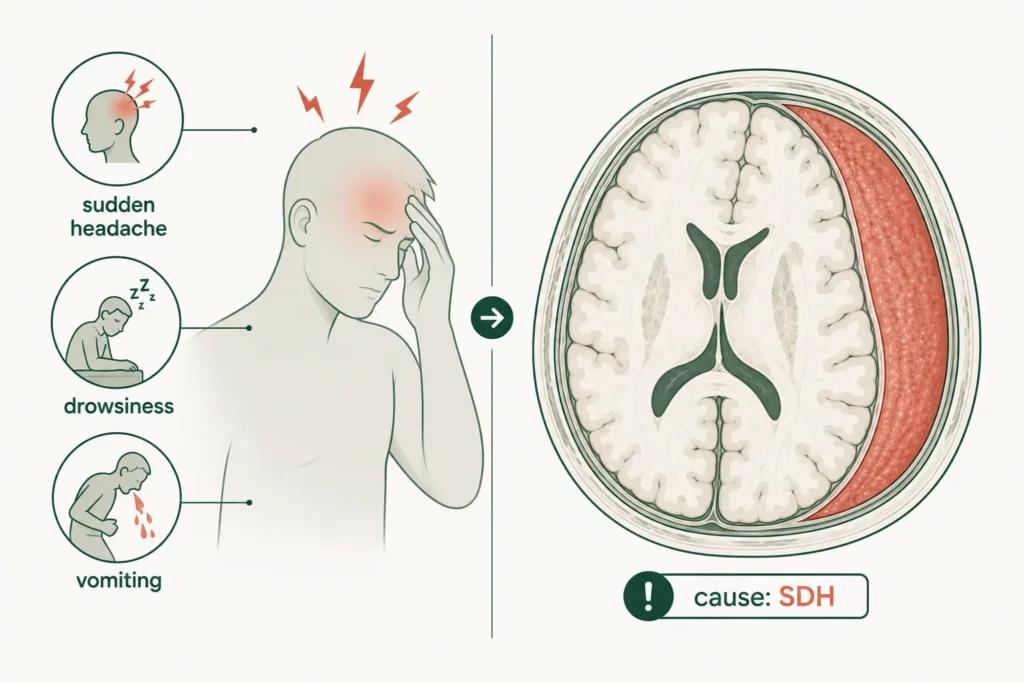
He Woke Up With a Headache. By Evening, He Wouldn’t Stay Awake. There Was Blood on His Brain.
At a Glance
| Patient | 75-year-old male |
| Complaint | Sudden headache, increased sleepiness, two episodes of vomiting |
| Background | Known hypertension; previous heart bypass surgery (CABG) |
| Diagnosis | Right acute on chronic subdural haematoma with midline shift and mass effect |
| Procedure | Right Middle Meningeal Artery embolisation via right femoral artery approach |
| Outcome | Post-operative CT confirmed successful coil embolisation of right MMA |
A 75-year-old man woke up with a headache. By the time his family brought him in, he was sleeping far more than normal and had vomited twice. He had a history of high blood pressure and had previously undergone heart bypass surgery, making any invasive intervention significantly more risky than in a healthy patient.
Something was pressing on his brain. And it needed to be treated carefully.
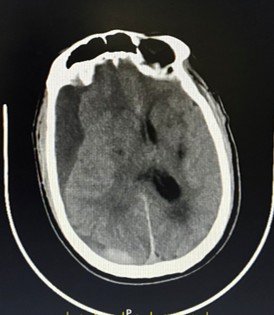
CT scan showing large right-sided subdural haematoma, mixed density collection indicating
acute bleeding on top of a chronic bleed, with brain shift.
Reach Out for Expert Care
What Did The Scan Show?
The CT scan confirmed a large blood collection on the right side of the brain, old blood with fresh bleeding on top, pushing the brain off its midline.
The NCCT showed a large extra-axial mixed-density concavo-convex collection on the right side, consistent with a subdural hematoma with both old and new blood. This is called an acute on chronic SDH: a chronic collection that had been slowly building over time, with a fresh bleed now layered on top.
The combined volume was large enough to cause significant mass effect, pressure on the brain tissue, and a shift in the brain’s midline, a reliable indicator of how much the brain is being pushed and compressed.
The sudden headache, excessive sleepiness, and vomiting were all direct consequences of this rising pressure inside the skull.
The Challenge
In a 75-year-old with hypertension and a prior heart bypass, open surgical drainage is a significant risk, and in acute on chronic SDH, it may not even address the underlying cause.
This patient’s cardiac history meant that open surgery under general anaesthesia carried elevated risk. His accelerated hypertension added further complexity. Standard burr hole drainage, while effective at removing the immediate collection, does not address the Middle Meningeal Artery, the blood vessel feeding the outer membrane of the haematoma, which continues to drive reaccumulation after drainage.
The decision was made to treat this with Middle Meningeal Artery embolization, a minimally invasive endovascular approach that targets the root cause of the hematoma without any incision in the skull.
Procedure: What Was Done?
Right MMA embolisation was performed through the right femoral artery, a single puncture in the groin, no incision on the head, no open brain surgery.
A catheter was introduced through a single-wall puncture of the right femoral artery in the groin and navigated under continuous image guidance through the blood vessels to the right Middle Meningeal Artery, the artery supplying the outer membrane of the brain where the haematoma had formed.
The right MMA was then selectively embolised using coils, tiny metallic devices delivered precisely through the catheter to block the artery from within. With the blood supply to the haematoma membrane cut off, the membrane can no longer sustain or reaccumulate the collection, allowing the body to gradually reabsorb the old blood over the weeks that follow.
The entire procedure was performed through a single puncture in the groin. No incision on the skull. No open surgery.
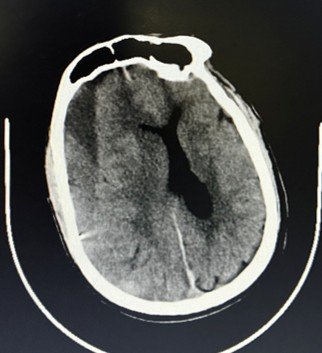
Post-operative CT scan confirming coil embolisation of the right middle meningeal artery, post-operative changes visible
along right parieto-temporal convexity.
Outcome
Post-operative CT confirmed successful coil embolisation of the right Middle Meningeal Artery, with post-operative changes visible along the right parieto-temporal convexity consistent with the procedure. The haematoma reabsorption process, as expected in chronic SDH cases following MMA embolisation, continues gradually over the weeks following the procedure as the body clears the old blood collection.
Why Does This Case Matter?
Sudden headache with drowsiness and vomiting in an elderly person is a neurological emergency until proven otherwise. This is not a combination of symptoms to observe at home.
The triad of headache, excessive sleepiness, and vomiting in an elderly patient, particularly one with a history of hypertension, should prompt immediate brain imaging. In this case, a large subdural haematoma with midline shift was found and treated the same day.
What this case also illustrates is the expanding role of MMA embolisation in patients who are at high surgical risk. For elderly patients with cardiac history, prior surgery, or significant comorbidities, a minimally invasive endovascular approach offers effective treatment with substantially lower procedural risk than open surgery.
A single puncture in the groin. A blocked artery. A brain no longer under pressure.
If an elderly family member develops sudden, severe headache with drowsiness or vomiting, treat it as an emergency. Do not wait.
Learn more about Subdural Haematoma Treatment, Middle Meningeal Artery Embolisation, Brain Stroke Treatment and Neurointerventional Procedures, or book a consultation with Dr. Vikas Gupta for a neurological evaluation.
This case study is published for educational and awareness purposes only. It does not constitute medical advice. Seek immediate emergency care for sudden severe headache, drowsiness, or vomiting in an elderly person.

 WhatsApp