Brain Clot vs Stroke vs Brain Haemorrhage: What Is the Difference?
A family member is rushed to hospital and the doctor says “stroke”. The next day, the scan report mentions a “clot” or a “bleed”. It is natural to wonder whether these are three different illnesses.
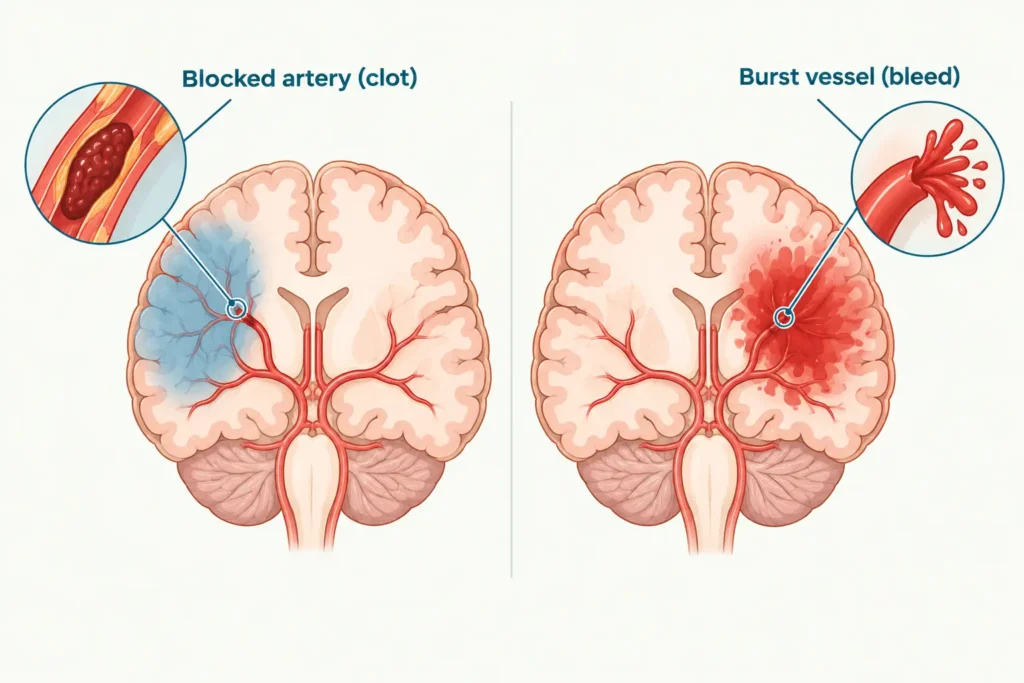
They are not. In brief: a stroke is the event, and a brain clot and a brain haemorrhage are the two main reasons it happens. A clot blocks blood flow to the brain, while a haemorrhage is bleeding in or around the brain. The distinction matters because their treatments are almost opposite. This guide explains the difference between a brain clot, a stroke and a brain haemorrhage, how to recognise each, and what to do in an emergency.
Reach Out for Expert Care
Is a brain clot the same as a stroke?
A brain clot is not a separate disease; it is the most common cause of stroke. When a clot blocks an artery that supplies the brain, the result is called an ischaemic stroke.
- A clot can form in a narrowed brain artery, or travel there from the heart or the neck arteries.
- Once blood flow stops, brain cells begin to lose oxygen within minutes, which is why speed matters.
- A clot that dissolves on its own can cause a short warning episode called a TIA (mini-stroke).
- Clots can also form in the brain’s veins (cerebral venous thrombosis). This is less common and can affect younger adults.
- A 2024 meta-analysis in the Indian Journal of Community and Family Medicine found that ischaemic stroke makes up roughly 67% to 74% of strokes in India.
So when someone says “brain clot”, doctors usually mean an ischaemic stroke. You can read more on why brain clots are becoming more common.
What is a brain haemorrhage, and is it also a stroke?
A brain haemorrhage is bleeding in or around the brain. When a weakened vessel inside the brain bursts, it is called a haemorrhagic stroke.
- Intracerebral haemorrhage: bleeding within brain tissue, most often linked to long-standing high blood pressure.
- Subarachnoid haemorrhage: bleeding over the brain’s surface, commonly from a ruptured brain aneurysm. It is often announced by a sudden, severe headache.
- Other causes include an arteriovenous malformation (AVM), head injury, blood-thinning medicines and, occasionally, tumours.
- Bleeds are the smaller share but far from rare. ICMR’s population-based stroke registries report haemorrhagic stroke in roughly 12% to 35% of cases, depending on the region studied.
A bleed harms the brain through pressure and swelling, which is why brain haemorrhage treatment focuses on controlling bleeding rather than restoring flow.
Brain clot vs stroke vs brain haemorrhage: what is the difference?
Brain clot is a cause, a stroke is the event, and a haemorrhage is the other cause: a clot blocks blood flow, a haemorrhage leaks blood, and either can result in a stroke.
| Brain clot | Stroke | Brain haemorrhage | |
| What it is | A blockage in a brain artery or vein | Sudden loss of blood supply to part of the brain | Bleeding in or around the brain |
| What happens | Blood cannot reach brain cells | Brain cells are damaged within minutes | Blood and pressure damage brain tissue |
| Relationship to stroke | Causes an ischaemic stroke | The umbrella term for both causes | Causes a haemorrhagic stroke |
| Common causes | Narrowed arteries, irregular heartbeat, clots from the heart or neck | Blockage or bleed | High blood pressure, aneurysm, AVM, head injury, blood thinners |
| Typical warning signs | Painless one-sided weakness, slurred speech, vision loss | Face drooping, arm weakness, speech difficulty | Sudden severe headache, repeated vomiting, seizure, drowsiness |
| Main treatment approach | Restore blood flow | Depends on the cause, confirmed by a scan | Control bleeding and pressure |
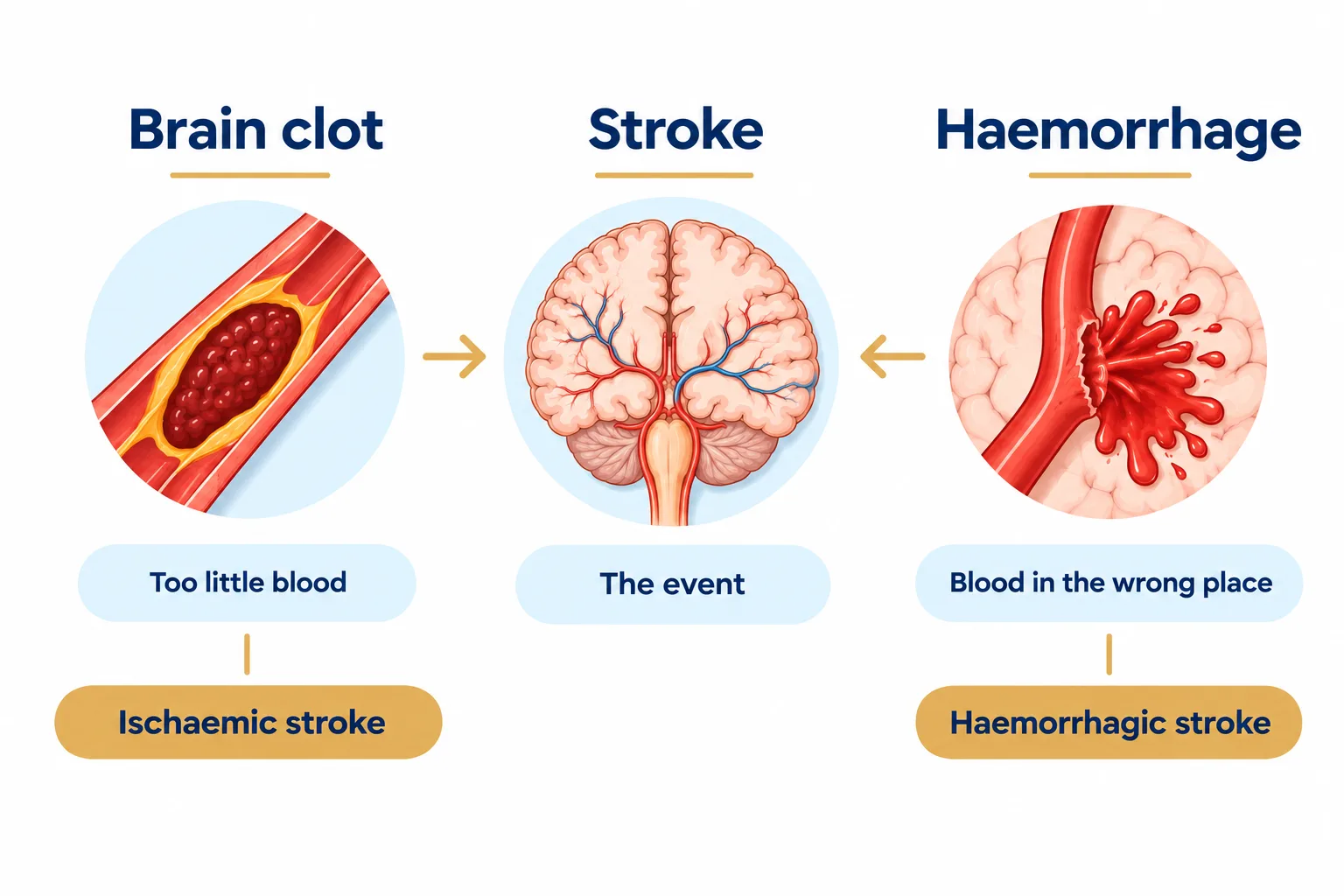
Think of it as a pipe problem: the pipe is either blocked or burst, and the brain pays the price either way.
How do the symptoms differ?
Clot-related and bleed-related strokes cause overlapping symptoms and cannot be told apart without a brain scan, so every sudden symptom should be treated as an emergency.
- Use BE-FAST: Balance loss, Eye or vision changes, Face drooping, Arm weakness, Speech difficulty, Time to act.
- More typical of a clot: sudden painless weakness or numbness on one side, slurred speech, vision loss.
- More typical of a bleed: sudden severe headache, repeated vomiting, seizure, quick drowsiness or loss of consciousness.
- Symptoms that settle within minutes still need urgent evaluation, as they may be a TIA.
Share our guide on the first signs of a stroke with family members.
How do doctors tell a clot from a bleed?
A CT or MRI brain scan is the fastest way to tell a clot from a bleed, and it must be done before any clot-dissolving treatment is considered.
- Non-contrast CT scan: shows fresh bleeding within minutes.
- MRI: picks up early or small ischaemic strokes that a CT may miss.
- CT or MR angiography, sometimes DSA: map the arteries and find blockages, aneurysms or AVMs.
- Blood tests, ECG, blood pressure and sugar checks: look for causes such as irregular heartbeat.
This is why aspirin or home remedies should never be given before a scan; in a bleed, they can make things worse.
How are a brain clot and a brain haemorrhage treated differently?
Clot-related strokes are treated by restoring blood flow, while bleeds are treated by controlling bleeding and pressure, so the two can never be managed the same way.
- For a clot: clot-dissolving medicine (thrombolysis) for eligible patients, usually within about 4.5 hours of onset. Mechanical thrombectomy can remove a large clot in selected patients, sometimes up to 24 hours when imaging supports it.
- For a bleed: blood pressure control, reversal of blood thinners and neuro-ICU monitoring.
- When an aneurysm or AVM is the source: surgical clipping, endovascular coiling or AVM embolisation may be used to seal it.
- For dangerous swelling: decompressive surgery may be needed to relieve pressure.
The right choice depends on the type, size, location and time since onset, so every case is individual.
Can brain clots and brain haemorrhages be prevented?
In many people, yes. Both share a common root in uncontrolled blood pressure, so controlling it, along with sugar and cholesterol, lowers the risk of both.
- Check blood pressure regularly. See high blood pressure and stroke risk.
- Manage diabetes and cholesterol, and treat atrial fibrillation (irregular heartbeat) if diagnosed.
- Stop tobacco in every form. See smoking and stroke.
- Stay active, cut down on salt and limit alcohol.
- Never stop or change blood thinners without medical advice.
- Narrowed neck arteries can be a source of clots, so carotid disease may need a scan when indicated.
Some strokes cause no obvious symptoms at all; read about silent stroke.
What should you do if you suspect a stroke in Delhi?
If you suspect a stroke, note the time symptoms began and go to the nearest hospital with a 24-hour CT scan and stroke-care facility; do not wait to see whether symptoms pass.
- Call an ambulance (112 is the national emergency number) instead of waiting at home.
- Note when the person was last seen normal. Doctors use this to decide on treatment.
- Do not give food, water, aspirin or home remedies. If the person is drowsy, lay them on their side.
- Carry the medicine list and any old reports.
- Understand why the first few hours matter.
Questions about a scan report or stroke risk are best discussed with a qualified neurologist or neurosurgeon.
Sources:
- Indian Journal of Community and Family Medicine (2024): “Age, gender, and regional variations in stroke epidemiology in India: A systematic review and meta-analysis” (Joseph et al.). This is the source for ischaemic stroke making up roughly 67% to 74% of strokes in India.
- ICMR-NCDIR (Indian Council of Medical Research, National Centre for Disease Informatics and Research): “Stroke Incidence and Mortality: A Report of the Population Based Stroke Registries, India” (Stroke Fact Sheet, 2018-19). This is the source for haemorrhagic stroke at roughly 12% to 35% depending on region.
- Treatment windows (about 4.5 hours for thrombolysis, up to 24 hours for selected thrombectomy cases): American Heart Association/American Stroke Association acute ischaemic stroke guidelines.

 WhatsApp